The Role of Guardians in University Choice Explained

TL;DR:
- Guardians significantly influence university choices through financial control, geographic boundaries, and cultural preferences. Their emotional, cultural, and social pressures often shape decisions more than students realize, highlighting the importance of transparency and shared understanding. Using official digital resources and clear communication helps guardians support autonomous student decision-making effectively.
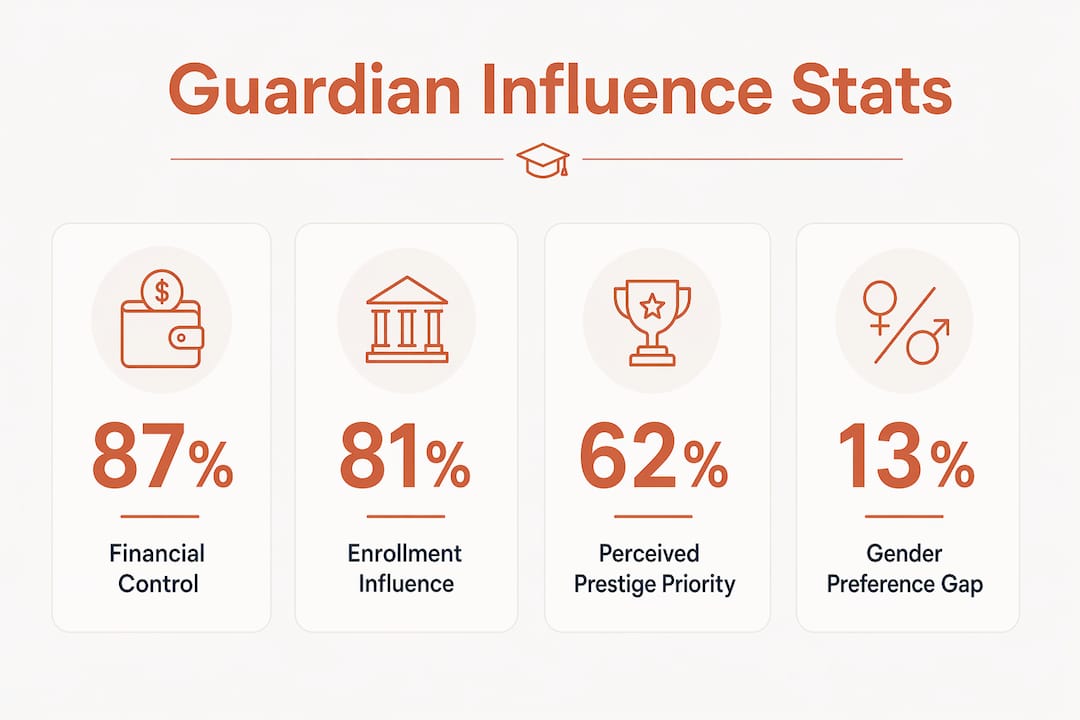
The role of guardians in university choice is the decisive influence that shapes where, how, and whether students pursue higher education at all. Guardians, the term used interchangeably with parents and primary caregivers in higher education research, do far more than sign tuition checks. According to a 2026 Advance Education survey, 87% of parents control total education spending, 81% influence enrollment decisions, and nearly 75% shape the choice of major. Those numbers reframe the entire college search: the student may be the applicant, but the guardian is often the decision architect. For international families considering universities in the UAE, understanding this dynamic is the first step toward making it work for everyone.
How do guardians practically influence the university selection process?
Guardian influence over university selection operates through three distinct channels: financial control, geographic boundaries, and institutional preferences. Each one narrows the field before a student ever submits an application.
Financial gatekeeping is the most direct mechanism. Guardians set budget constraints and interpret financial aid packages, which means their perception of affordability often diverges from actual costs. A family that misreads a scholarship offer as insufficient may eliminate a genuinely affordable option. Financial influence, in other words, goes beyond the budget itself into how families process and communicate about money.
Geographic and safety limits come next. Many guardians impose location boundaries, sometimes explicitly (“no more than two hours from home”) and sometimes implicitly through repeated expressions of concern about specific cities or countries. For international students, this dynamic intensifies. A guardian unfamiliar with Dubai may default to anxiety rather than research, which is why transparent information becomes critical.
Institutional type preferences round out the picture. Guardians frequently favor universities that mirror their own educational experiences or align with what their social circle values. This is where the prestige question gets complicated.
- Guardians control the financial ceiling that determines which universities are even considered
- Geographic comfort zones, stated or unstated, eliminate entire regions from the search
- Institutional preferences based on personal history can override a student’s genuine fit
- Aid package interpretation shapes perceived affordability regardless of actual net cost
- Social circle expectations create pressure that guardians may not consciously recognize
Pro Tip: Ask your student to share the full cost breakdown from each university’s official financial aid page before discussing affordability. Guardians who review raw numbers rather than summaries make more accurate comparisons.
What are the emotional and cultural factors affecting guardians’ involvement?
The practical channels of influence described above do not operate in an emotional vacuum. Guardians bring grief, anxiety, cultural expectations, and social pressure into every university conversation, often without realizing it.
Parents frequently experience grief and emotional adjustment when a child prepares to leave for college. This grief can manifest as control, over-involvement, or decision paralysis. A guardian who keeps adding universities to the list, or who raises new objections every time a decision seems close, may not be indecisive. They may be processing the emotional reality of an empty nest. Recognizing this pattern is the first step toward separating emotional needs from practical guidance.
Cultural dynamics add another layer. A 2026 study found that South Asian parents send 13 percentage points more daughters than sons to Western universities, while simultaneously imposing stricter housing and safety rules for those daughters. Gender protectionism, rooted in genuine care, can paradoxically expand and restrict opportunity at the same time.
The prestige question reveals a striking gap between private preference and social performance. Consider this comparison:
| Guardian behavior | What research shows |
|---|---|
| Personal priority on prestige | Only 16% of parents ranked prestige as their top concern |
| Perceived community expectation | 62% believed prestige mattered to their wider social circle |
| Actual decision driver | Social perception, not personal conviction, often dominates |
| Result for students | Families pursue brand-name institutions that may not be the best fit |
That gap, 16% versus 62%, is one of the most revealing findings in recent higher education research. Guardians are frequently making choices based on what they think their neighbors value, not what they actually believe. Naming this dynamic out loud, in a calm conversation with your student, can free both of you from a constraint that was never real.
Pro Tip: Before any university discussion, write down your top three priorities privately. Then ask your student to do the same. Comparing lists reveals where you genuinely agree and where social pressure has been masquerading as shared values.
How do students and guardians collaborate and sometimes clash during university choice?
The relationship between student autonomy and guardian influence is not a tug of war. It is a relay race where the baton gets passed at different moments, and the handoff is where most problems occur.
Students initiate the college search through people: family, friends, and teachers. Guardians then validate those choices using official digital sources to reduce perceived risk. This creates a dual influence system where the student generates options and the guardian filters them. The model works well when both parties understand their roles. It breaks down when guardians begin generating options too, which collapses the student’s sense of ownership over the process.

Parental enthusiasm and nonverbal reactions frequently tip final university decisions. A student who senses genuine excitement from a guardian about one institution, and quiet skepticism about another, will often follow that emotional signal even when the logic points elsewhere. Guardians who think they are staying neutral rarely are.
Here are four strategies that help guardians balance influence with genuine support:
- Verbalize your boundaries early. State your financial ceiling, geographic preferences, and non-negotiables at the start of the search, not after a student has fallen in love with an option you cannot support.
- Ask questions instead of offering opinions. “What drew you to that program?” generates more useful information than “I’m not sure about that one.” It also keeps the student in the driver’s seat.
- Give explicit emotional permission. Tell your student directly that you are excited for them and that you will support their choice. Students who receive this signal make faster, more confident decisions.
- Separate your grief from their decision. If you notice yourself raising new objections as a final decision approaches, pause and ask whether the concern is about the university or about the transition itself.
The parental involvement in tutoring research reinforces a consistent finding: guardians who shift from gatekeepers with rigid rules to partners who empower student autonomy produce better academic and emotional outcomes. The goal is not less involvement. It is smarter involvement.
What digital tools and resources do guardians use to support university choices?
Guardians and students use digital resources differently, and understanding that gap helps both parties contribute more effectively to the search.
Students start with social media, peer networks, and informal recommendations. Guardians move quickly to official sources: university websites, government accreditation databases, financial disclosure documents, and structured search platforms. This division of labor is actually productive when it is intentional. The student surfaces options through lived networks; the guardian stress-tests those options through official data.
Penn State research from 2025 confirms that admissions professionals must now account for layered decision-making influenced by digital and political contexts alongside traditional networks. For guardians, this means the information environment has become more complex, not simpler. A university’s social media presence and its official accreditation status can tell very different stories.
Practical digital resources guardians should prioritize include:
- Official university websites with published tuition, housing costs, and accreditation details
- Government-recognized accreditation databases for the country where the university operates
- Structured university finder platforms that aggregate verified institutional profiles
- Financial aid calculators that convert sticker prices into net cost estimates
- Virtual campus tours and recorded information sessions that reduce the need for expensive in-person visits
For families researching UAE universities, platforms like Khalifa University and Murdoch University Dubai maintain detailed institutional profiles that give guardians the cost, program, and accreditation data they need to validate a student’s interest with confidence.
Pro Tip: Cross-reference any university’s tuition figures against the institution’s official government-recognized accreditation status before discussing costs. Accreditation affects graduate employability and degree recognition far more than tuition level does.
Key takeaways
The role of guardians in university choice is defined by financial control, emotional influence, and cultural expectations that operate simultaneously, and the most effective guardians learn to manage all three with transparency and empathy.
| Point | Details |
|---|---|
| Financial control is primary | 87% of guardians control education spending, making budget conversations non-negotiable from the start. |
| Emotional signals tip decisions | Parental enthusiasm and nonverbal reactions frequently determine a student’s final university choice. |
| Social pressure distorts priorities | Only 16% of parents personally prioritize prestige, yet 62% act as if their community demands it. |
| Cultural factors shape boundaries | Gender protectionism and cultural norms create implicit restrictions that students and guardians should name openly. |
| Digital validation builds trust | Guardians who use official university profiles and accreditation data reduce perceived risk and support confident decisions. |
What I’ve learned about guardians who get this right
After working with hundreds of international student families through the university search process, the pattern I see most clearly is this: the guardians who produce the best outcomes are not the ones who do the most research. They are the ones who do the right research at the right time and then hand the wheel back to their student.
The grief dynamic is real and underappreciated. I have watched guardians torpedo a student’s genuine enthusiasm for a program by raising a logistical objection that was, on examination, a proxy for “I’m not ready for you to leave.” That is a legitimate feeling. It deserves acknowledgment, not suppression. But it should not be dressed up as a concern about campus safety or graduate employment rates.
The prestige gap, 16% personal priority versus 62% perceived community expectation, is the single most useful data point I share with guardian groups. When you show a parent that number, something visibly shifts. They realize they have been performing a preference they do not actually hold. That realization creates space for a more honest conversation about what the family genuinely values: proximity, cost, program quality, or career outcomes.
My advice to guardians of international students specifically: get comfortable with uncertainty earlier than feels natural. Dubai and Abu Dhabi are not unfamiliar territory. They are structured, internationally accredited, and home to campuses from institutions like Middlesex University and Amity University. The study tips for parents literature consistently shows that guardians who engage with specific, factual information about a destination reduce their own anxiety faster than those who rely on general impressions. Read the accreditation reports. Review the housing options. Then trust your student with the decision.
— Jogo
How Find-my-uni supports guardians and students together
Find-my-uni is built for exactly the dynamic this article describes: a student with genuine interests and a guardian who needs verified, transparent information to feel confident about the choice. The platform aggregates detailed profiles for universities across Dubai and Abu Dhabi, including tuition figures, program accreditation, housing options, and admission requirements, all in one place. Guardians can review institutional data for options like Abu Dhabi University or United Arab Emirates University without navigating multiple official websites. The AI-powered matching system then aligns student academic profiles with programs that fit, giving both parties a shared starting point for the conversation. Start the search at Find-my-uni and turn guardian involvement into a genuine advantage.
FAQ
How much influence do guardians have on university enrollment?
81% of parents influence enrollment decisions directly, according to a 2026 Advance Education survey. This makes guardian buy-in one of the strongest predictors of whether a student actually enrolls in their preferred institution.
Why do guardians prioritize prestige even when they say they don’t?
Research shows only 16% of parents personally prioritize prestige, but 62% believe their wider community does. Guardians often make prestige-driven choices to meet perceived social expectations rather than their own stated values.
How do cultural backgrounds affect guardian involvement in university choice?
Cultural norms, particularly around gender, shape both the universities guardians consider and the conditions they attach to attendance. South Asian parents, for example, send more daughters to Western universities but apply stricter housing and safety requirements to those placements.
What is the most effective way for guardians to support a student’s university decision?
Guardians who verbalize financial and geographic boundaries early, give explicit emotional permission, and use official digital sources to validate options produce faster and more confident student decisions. Shifting from gatekeeper to informed partner is the most effective posture.
Should guardians research universities independently from their students?
Yes, but with a specific purpose. Students surface options through social and peer networks; guardians validate those options through official institutional data and accreditation records. Keeping these roles distinct prevents overlap that can undermine student ownership of the decision.