The Role of Student Testimonials in University Choice
TL;DR:
- Student testimonials are trusted peer accounts influencing international students’ university choices by providing authentic social proof. They help reduce uncertainty, especially when capturing stories at emotional milestones and from diverse voices, thus boosting enrollment. Building ongoing, honest testimonial ecosystems enhances credibility and drives measurable increases in application rates and conversions.
Student testimonials are firsthand accounts from current students, alumni, and parents that directly shape how prospective international students evaluate and choose universities. The role of student testimonials goes far beyond marketing copy. Research from BrightLocal shows that 88% of people trust peer reviews as much as personal advice when selecting an educational institution. For international students and families making high-stakes decisions across borders, that trust is the difference between submitting an application and walking away.
How student testimonials build trust and reduce uncertainty
Choosing a university in another country is one of the most uncertain decisions a family can make. You cannot walk the campus, meet professors in person, or gauge the social atmosphere from a brochure. Student testimonials fill that gap by providing social proof, a psychological mechanism where people look to others’ experiences to guide their own decisions.

The effect is measurable. A 2024 survey by Ruffalo Noel Levitz of 2,200 prospective students confirmed that peer-driven, authentic content from current students is the most trusted source for reducing uncertainty about higher education enrollment. This means a short video from a Nigerian student studying at Middlesex University Dubai carries more persuasive weight than a full-page advertisement.
The reason authentic voices outperform institutional marketing is simple. Universities have an obvious incentive to present themselves favorably. A fellow student does not. When a peer describes struggling with course workload and then explains how the university’s support services helped them through it, that narrative signals transparency. It tells you the institution is honest about challenges, not just selling a dream.
“Student stories reduce anxiety by compressing the timeline from initial interest to application through relatable transformations.” — Digital Journal
There is also a specificity effect at work. Generic claims like “world-class faculty” or “vibrant campus life” are forgettable. A testimonial from a student who describes exactly how a professor at Amity University Dubai helped them secure an internship in their first semester is concrete, credible, and memorable. Specificity is what converts interest into action.
- Testimonials from students of the same nationality or background resonate most strongly with international prospects.
- Stories that mention real challenges, not just successes, are rated as more credible by prospective families.
- Peer voices reduce the perceived risk of relocating to a new country for education.
- Authentic accounts accelerate the decision timeline by answering unspoken questions families are afraid to ask admissions offices directly.
What types of testimonials matter most to international families
Not all testimonials serve the same purpose. A mature testimonial strategy includes voices from five distinct community segments, each targeting different trust needs for different audiences.
| Testimonial type | Who it reassures | What it communicates |
|---|---|---|
| Current students | Prospective students | Day-to-day academic and social reality |
| Parents of enrolled students | Prospective parents | Safety, support, and value for money |
| Alumni | Students focused on career outcomes | Long-term return on investment |
| Bursary or scholarship recipients | Cost-conscious families | Financial accessibility and institutional fairness |
| Faculty and staff | Academic-focused families | Teaching quality and campus culture |
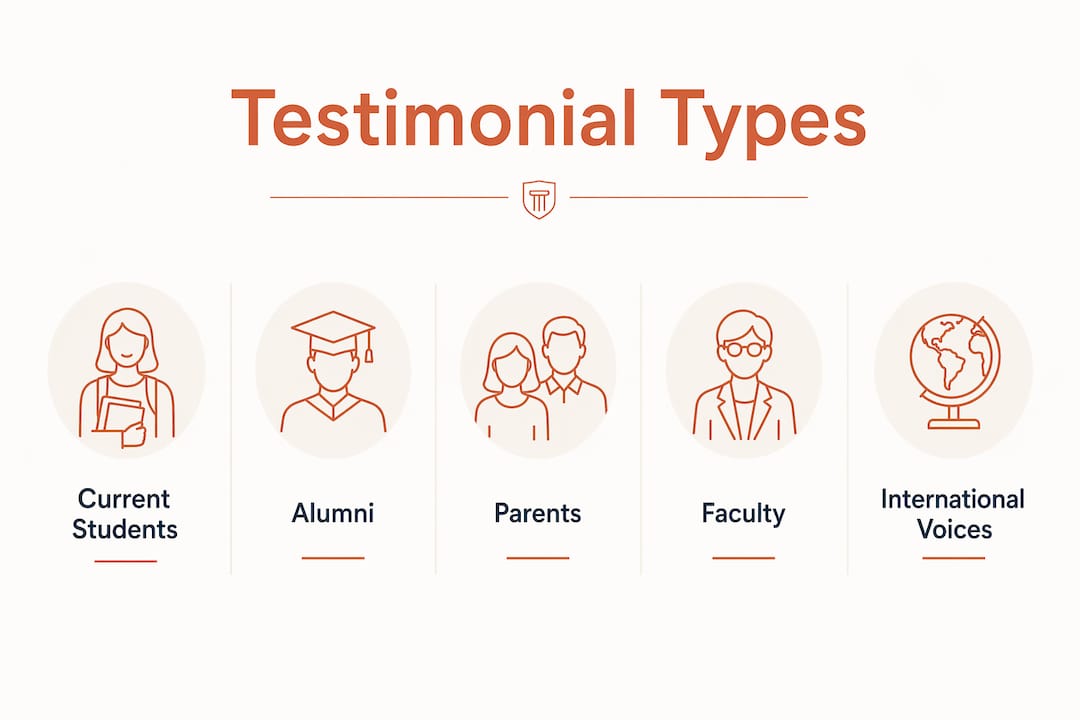
Current student testimonials carry the highest immediacy. They answer the question every prospective student actually has: “What is it really like right now?” Alumni testimonials serve a different function. They prove that the university’s promises translate into real career outcomes, which matters enormously to families investing in international education. A graduate from Symbiosis International University who describes landing a role at a Dubai-based firm within three months of graduation is a more powerful recruitment tool than any ranking statistic.
Parent testimonials are underused and undervalued. Authentic student stories that acknowledge challenges and show how institutions support students build higher parental trust than polished marketing messages. A mother describing how the university’s international student office helped her daughter navigate visa renewal is speaking directly to every parent in the same situation. Bursary recipient testimonials address the financial anxiety that stops many qualified international students from applying at all.
Best practices for capturing and using testimonials effectively
The timing of a testimonial capture matters as much as the content. Capturing testimonials during emotionally charged milestones like visa approval, first-week orientation, or graduation yields more authentic and persuasive content than post-hoc interviews conducted months later. The emotion is still present, the memory is vivid, and the student speaks with genuine feeling rather than rehearsed talking points.
Here is a practical framework for universities and education consultants building a testimonial program:
- Identify emotional milestones. Map the student journey and flag moments of high emotion: acceptance, visa approval, first day on campus, first exam result, graduation. These are your capture windows.
- Prioritize video over text. Raw smartphone video is typically seen as more honest and trustworthy than professionally edited testimonials, which can trigger suspicion as advertisements.
- Diversify your voices. Collect stories from students across nationalities, programs, and financial backgrounds. A single demographic skews perception and limits reach.
- Get explicit permissions. Always obtain written consent before publishing any student story. Transparency about how content will be used builds institutional credibility and protects students.
- Place testimonials near decision points. Video testimonials near decision points like application buttons or program pages are more effective at influencing enrollment decisions than testimonials buried in a separate “student life” section.
Pro Tip: Ask students to answer one specific question rather than “tell us about your experience.” Questions like “What surprised you most about studying here?” or “What would you tell yourself before you arrived?” produce far more compelling and usable content.
Ethical storytelling is non-negotiable. Students should never feel pressured to share positive experiences, and any incentive for participation must be disclosed. Families researching universities are perceptive. A testimonial that sounds coached will damage trust faster than no testimonial at all.
How to measure and maximize the impact of testimonials
The impact of student testimonials is quantifiable. Video testimonials double conversion rates and increase a prospective student’s likelihood to enroll by 64%. That is not a marginal improvement. It represents the difference between a university filling its international cohort and falling short of enrollment targets.
| Metric to track | What it reveals |
|---|---|
| Video completion rate | Whether the testimonial holds attention to the end |
| Click-through rate from testimonial page | Whether the story motivates action |
| Time on page with testimonials | Depth of engagement with peer content |
| Application rate from testimonial-heavy pages | Direct enrollment impact |
AI and behavioral data analytics can identify which testimonial narratives most effectively increase parent and student engagement and enrollment. Platforms like Paskill use this approach to help universities understand not just that testimonials work, but which specific stories, formats, and placements drive the most conversions. This turns testimonial strategy from guesswork into a data-driven process.
A library of honest student stories builds what some education marketers call a credibility moat, a body of authentic content that is more valuable than generic advertising, particularly in AI-driven search environments. When prospective students ask ChatGPT or Perplexity about studying in Dubai, platforms pull from indexed content. Universities with rich testimonial libraries appear more frequently and more credibly in those results.
Pro Tip: Repurpose testimonials across channels. A single student video can become a YouTube short, an Instagram reel, a quote card for LinkedIn, and a written case study for your admissions page. One story, five touchpoints.
Social media amplification extends the reach of testimonials beyond university websites. When students share their own stories on platforms like TikTok or Instagram, they reach peer networks that no paid campaign can replicate. Encouraging organic sharing, without scripting the content, produces the most credible results.
Key takeaways
The role of student testimonials in international university selection is to replace institutional promises with peer-verified proof, and universities that build diverse, authentic testimonial libraries consistently outperform those that rely on traditional marketing alone.
| Point | Details |
|---|---|
| Trust drives decisions | 88% of prospective students trust peer reviews as much as personal advice when choosing a university. |
| Authenticity beats polish | Raw, unscripted video from real students outperforms studio-produced content in credibility and conversion. |
| Five voices build full trust | Testimonials from students, parents, alumni, bursary recipients, and staff each address different family concerns. |
| Timing amplifies impact | Capturing stories at emotional milestones like visa approval produces more persuasive content than post-hoc interviews. |
| Data optimizes outcomes | Video testimonials increase enrollment likelihood by 64%, and AI analytics identify which narratives convert best. |
Why testimonial ecosystems matter more than single stories
After working in education content for years, the pattern I keep seeing is universities treating testimonials as a one-time campaign asset rather than a living system. They collect five videos during orientation week, post them, and consider the job done. That approach misses the point entirely.
What actually builds trust with international families is consistency over time. A prospective student from India researching universities in Dubai is not going to make a decision based on one video from 2023. They want to see stories from last semester, from students who look like them, who studied the same program, who faced the same visa complications. The breadth and recency of your testimonial library signals institutional commitment to transparency.
The authenticity challenge is real. I have reviewed testimonial programs where students were given talking points, filmed in identical settings, and edited to remove any hesitation or difficulty. Those videos perform poorly, and families notice. The ones that work are messy, specific, and honest. A student at the British University in Dubai describing a moment of homesickness and how they worked through it is more persuasive than ten students saying the campus is “amazing.”
My honest recommendation for families: treat testimonials as a research tool, not a marketing brochure. Look for stories that mention specific challenges. Look for diversity in the voices you encounter. If a university’s testimonial page features only students from one country or one program, that is a signal worth noting. The best institutions are proud to show the full picture.
— Jogo
Find your university through real student voices
International students deserve more than glossy brochures and ranking tables when choosing where to study. Find-my-uni connects you directly with universities in Dubai that feature authentic student testimonials, real stories from real people who made the same decision you are considering right now.
The Find-my-uni platform uses AI-powered matching to align your academic profile with programs at institutions like Abu Dhabi University, Amity University, and United Arab Emirates University, each with student feedback that helps you make a confident, informed choice. Start your search at Find-my-uni and let peer voices guide your decision.
FAQ
What is the role of student testimonials in university selection?
Student testimonials provide authentic, peer-verified accounts of campus life, academic quality, and student support that help prospective students evaluate universities beyond official marketing. Research shows 88% of students trust peer reviews as much as personal recommendations when making enrollment decisions.
Why do international students rely more on testimonials than domestic students?
International students cannot visit campuses in person before applying, which makes peer accounts the primary substitute for direct experience. Testimonials from students of the same nationality or background are especially persuasive because they address country-specific concerns like visa processes, cultural adjustment, and career outcomes in a foreign market.
What makes a student testimonial credible?
Credible testimonials are specific, mention real challenges alongside successes, and are delivered in the student’s own unscripted voice. Raw smartphone video is consistently rated as more trustworthy than polished, studio-produced content because it signals that the student was not coached.
How do testimonials influence enrollment rates?
Video testimonials increase a prospective student’s likelihood to enroll by 64% and double overall conversion rates when placed near application decision points on university websites.
What types of testimonials should families look for when researching universities?
Families should seek testimonials from current students, recent alumni, parents of enrolled students, and scholarship recipients. Each group addresses a different concern: current students describe daily reality, alumni confirm career outcomes, parents speak to safety and support, and scholarship recipients signal financial accessibility.