Credit Transfer UAE: What International Students Must Know

TL;DR:
- Credit transfer in the UAE is a formal process where universities evaluate prior academic credits to grant exemptions, reducing coursework and tuition costs. Success relies on complete documentation, course equivalency, and understanding institutional caps, which typically limit transfers to about 50% of degree requirements. Early assessment and accurate syllabi are essential for maximizing credit transfer potential and avoiding enrollment delays.
Credit transfer in the UAE is defined as the formal process by which a university evaluates academic credits earned at a previous institution and applies qualifying credits toward a new degree program. For international students moving to Dubai or Abu Dhabi, this process can eliminate redundant coursework, reduce tuition costs, and shorten the time to graduation. Universities like the United International Business School (UIBS), Curtin University Dubai, and the American University in Dubai each maintain distinct policies governing how many credits they accept and under what conditions. Understanding how credit transfer works before you apply is the single most effective way to protect the academic progress you have already made.
What is credit transfer in UAE universities?
Credit transfer in UAE higher education centers on a course-by-course equivalency review. The receiving university compares each course you completed abroad against its own curriculum to determine whether the content, credit hours, and academic level are sufficiently similar to justify an exemption. Two students with the same credits can receive entirely different transfer outcomes depending on how closely their prior coursework maps to the new program’s requirements. This means your transfer result is never automatic, even if your grades were excellent.

The benefits of credit transfer in UAE programs are real and measurable. Accepted credits reduce the number of courses you must complete, which directly lowers tuition costs and can move your graduation date forward by one or two semesters. For families funding international education, that financial relief is significant. Beyond cost, credit transfer also spares you from repeating foundational material you have already mastered, letting you focus on advanced coursework from the start.
Credit transfer is the industry-standard term used by UAE institutions and the Ministry of Higher Education and Scientific Research (MOHESR). Some students search for “academic credit recognition” or “course exemption,” but UAE universities and government bodies consistently use “credit transfer” in their official policies and application portals.
How do UAE universities evaluate and accept transfer credits?
Universities in the UAE assess transfer credits against several specific criteria, and understanding each one helps you predict your outcome before you apply.
- Course content and curriculum alignment. The syllabus of your prior course must cover topics comparable to the equivalent course at the new university. A business statistics course from a European university may transfer cleanly to a UAE program if the weekly topics, learning outcomes, and assessment methods align. A course with the same name but a narrower scope may not.
- Credit hours and academic level. A 3-credit undergraduate course does not automatically substitute for a 4-credit course, even if the content overlaps. UAE universities match credit volume and course level (100-level, 200-level, and so on) before granting an exemption.
- Grades achieved. Most institutions set a minimum grade threshold, commonly a C or its equivalent, for a course to qualify for transfer. Courses you passed with low marks may be excluded from consideration entirely.
- Institutional accreditation. Recognition depends on the awarding institution’s accreditation status in its home country. Credits from unaccredited or provisionally accredited institutions are rarely accepted.
- Program-specific caps. UIBS, for example, caps Bachelor transfer at 120 credits or two-thirds of total program requirements, whichever is lower. This ceiling exists to preserve curriculum integrity and is a standard feature across most UAE degree programs.
Pro Tip: Request a pre-evaluation meeting with the admissions office before submitting a formal application. Many UAE universities will give you an informal read on which credits are likely to transfer, saving you weeks of waiting on a formal decision that may require revisions anyway.
What documentation is needed to transfer credits in UAE universities?
Preparing your paperwork correctly is where most credit transfer applications succeed or fail. Incomplete course documentation is the leading reason universities reduce the number of accepted credits, regardless of how strong your academic record is. Follow these steps to build a complete application file.
- Official transcripts. Request sealed, official transcripts directly from your previous institution. Unofficial or student-downloaded copies are not accepted by UAE universities.
- Detailed course syllabi. Each syllabus must include learning outcomes, weekly topic breakdowns, assessment methods, and the textbooks used. A one-page course description is not sufficient. Universities need the full document to conduct an equivalency review.
- No Objection Certificate (NOC). Some UAE universities require a clearance letter or NOC from your previous institution confirming you left in good academic standing and have no outstanding obligations.
- Identity and visa documents. Transcripts, syllabi, NOC, passport, Emirates ID, and visa documents are all standard requirements. If your visa status is still being processed, note that visa documentation can delay credit transfer timelines significantly.
- Online application submission. Most UAE universities now process credit transfer requests through dedicated online portals. Evaluation timelines typically run around five business days after a complete file is received, though complex cases take longer.
Early application for credit evaluation prevents enrollment delays and protects your semester registration. Submit your transfer file as soon as you receive an offer letter, not after orientation week.
Pro Tip: Translate all documents into English if your previous institution issued them in another language. Certified translations are required, and using a non-certified translator can invalidate your entire submission.
What are the typical credit transfer limits and how do they affect your study plan?
Credit transfer caps are one of the most misunderstood aspects of UAE higher education. Students often assume they can transfer everything they have earned, then discover mid-application that a hard ceiling applies. The table below shows common limits by degree type.
| Degree level | Typical maximum transferable credits | Program requirement context |
|---|---|---|
| Bachelor’s degree | Up to 120 credits or two-thirds of total requirements | A 180-credit program allows a maximum of 120 transferred credits |
| Master’s degree | Up to 20 credits or one-third of total requirements | A 60-credit program allows a maximum of 20 transferred credits |
| Diploma or associate | Up to 50% of total credits | Varies significantly by institution and program |
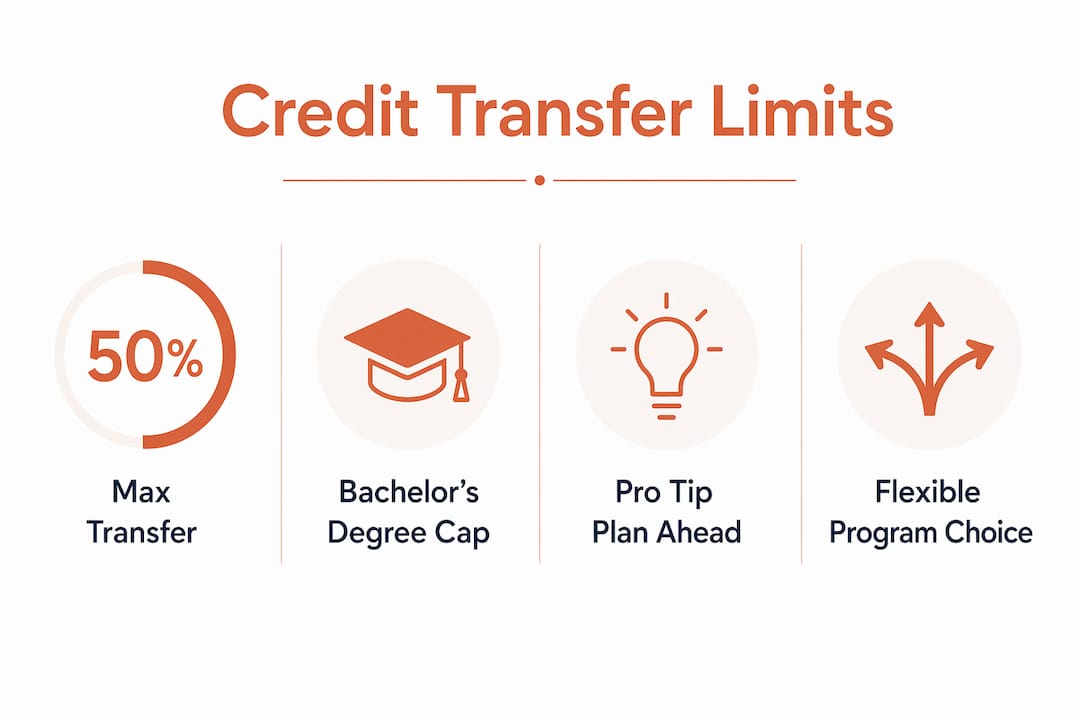
Most UAE universities limit transferable credits to around 50% of total degree credits, with specific numbers varying by program. This means even a student with a full year of completed coursework may find that only a portion qualifies under the cap. The practical implication is that you should plan your enrollment timeline around a realistic transfer outcome, not an optimistic one.
Selecting programs with flexible credit acceptance is the most effective strategy for maximizing exemptions. Some programs, particularly in business, engineering, and liberal arts, have broader equivalency frameworks that accommodate diverse international curricula. Highly specialized programs with rigid course sequences tend to accept fewer transfer credits because the curriculum leaves less room for substitution.
Partial transfer scenarios are common and worth planning for. If you transfer 60 credits into a 120-credit Bachelor’s program, you enter as a junior-level student with two years of coursework remaining. That outcome still saves you significant time and money compared to starting from scratch, but it requires accurate enrollment planning from day one.
How does foreign qualification recognition intersect with credit transfer?
Qualification recognition and credit transfer are related but distinct processes, and confusing the two is a costly mistake. Qualification recognition is distinct but complementary to credit transfer and both affect your academic path in the UAE.
The MOHESR evaluates whether a foreign degree or qualification meets UAE academic standards. Credit transfer, by contrast, is handled at the institutional level by individual universities. You can have a recognized qualification and still face restrictions on how many credits transfer into a new program.
Key factors that affect both processes include:
- Home country accreditation. The UAE Ministry requires that the institution awarding your prior qualification be accredited in its home country. Degrees from unaccredited institutions are not recognized, which also eliminates the possibility of credit transfer from those courses.
- Distance learning policies. The MOHESR issued a policy granting conditional recognition for distance learning with a maximum of 18 credit hours online per semester. Credits earned beyond that threshold in a single semester may not qualify for recognition or transfer.
- Verification agencies. Organizations like Dataflow and QuadraBay conduct credential verification on behalf of UAE institutions and government bodies. Their reports influence both recognition decisions and credit transfer outcomes.
- Policy updates. Ministry recognition criteria change periodically. Checking the MOHESR website directly before submitting any application is the only way to confirm current requirements.
Being proactive and thorough with paperwork significantly increases the chances of a smooth outcome across both recognition and transfer processes.
Key takeaways
Credit transfer in UAE universities succeeds when students submit complete documentation early, target programs with flexible equivalency policies, and understand that institutional caps typically limit transfers to 50% or two-thirds of total degree requirements.
| Point | Details |
|---|---|
| Credit transfer definition | UAE universities evaluate prior credits course-by-course for content, level, and grade equivalency. |
| Documentation completeness | Full syllabi with learning outcomes and assessments are required; missing documents reduce accepted credits. |
| Transfer credit caps | Bachelor’s programs typically cap transfers at 120 credits or two-thirds of requirements; Master’s at one-third. |
| Recognition vs. transfer | MOHESR qualification recognition and institutional credit transfer are separate processes that both affect your degree path. |
| Early submission matters | Submitting your transfer file immediately after receiving an offer letter prevents enrollment and visa delays. |
What I’ve learned watching students navigate UAE credit transfers
The single biggest mistake I see international students make is treating credit transfer as an afterthought. They accept an offer, arrive in Dubai, and then discover that the evaluation process takes weeks and that half their credits do not qualify because they submitted incomplete syllabi. By that point, they are already registered for courses they may not need, paying for a full semester when they could have entered at an advanced standing.
The students who come out ahead are the ones who start the credit evaluation process before they even finalize their university choice. They use that evaluation as a selection criterion. If University A accepts 60 of your 80 prior credits and University B accepts only 30, that difference represents real money and real time. Treating credit transfer as a comparison metric, not just an administrative step, changes the entire calculus of choosing where to study.
I also think students underestimate the power of a detailed syllabus. I have seen cases where a student’s credits were initially rejected because the submitted syllabus was a two-paragraph course description. When the student went back to their home university, retrieved the full 12-page document with weekly topics and assessment rubrics, and resubmitted, the university reversed its decision and accepted the credits. The academic content was always there. The documentation just did not prove it the first time.
One more thing worth saying plainly: credit transfer policies in the UAE are not static. Universities update their caps and equivalency frameworks, and the MOHESR updates its recognition criteria. A policy that applied to a student who enrolled two years ago may not apply to you today. Always verify directly with the institution and the ministry before making enrollment decisions based on secondhand information.
— Jogo
How Find-my-uni helps you compare credit transfer options in the UAE
Choosing the right UAE university when you have prior credits to transfer requires comparing not just programs and tuition, but specific transfer policies and credit caps. Find-my-uni makes that comparison straightforward.

Find-my-uni’s university finder for Dubai connects international students with accredited programs across Dubai and Abu Dhabi, with clear access to each institution’s admission requirements and transfer guidelines. The platform’s AI-powered matching system factors in your academic profile, so you are not browsing blind. Whether you are transferring from a European university, a North American institution, or another UAE campus, Find-my-uni helps you identify programs where your prior credits are most likely to count. Admission support, visa guidance, and housing assistance are also available, so your transition covers more than just academics.
FAQ
What is credit transfer in Dubai universities?
Credit transfer in Dubai universities is the process of applying credits earned at a previous institution toward a new degree program. Universities evaluate each course for content equivalency, credit hours, and grades before granting an exemption.
How many credits can you transfer to a UAE university?
Most UAE universities cap credit transfers at around 50% of total degree requirements. Bachelor’s programs at institutions like UIBS allow a maximum of 120 credits or two-thirds of program requirements, whichever is lower.
Is credit transfer safe in UAE universities?
Credit transfer in UAE universities is a formal, regulated process governed by individual institutional policies and MOHESR guidelines. Submitting complete documentation from accredited institutions makes the process predictable and reliable.
What documents are needed for credit transfer in UAE?
Required documents typically include official transcripts, detailed course syllabi, a No Objection Certificate from your previous institution, and identity documents such as your passport, Emirates ID, and visa.
Does online coursework qualify for credit transfer in the UAE?
The MOHESR conditionally recognizes distance learning credits with a maximum of 18 credit hours online per semester. Credits earned beyond that threshold in a single semester may not qualify for recognition or transfer into a UAE program.