Student Transportation in UAE: A Practical Guide
TL;DR:
- Student transportation in the UAE involves metro lines, buses, trams, water taxis, and university shuttles, all subsidized with emirate-specific discount cards. Combining these transit options with university-provided transport and ride-hailing apps helps students travel affordably and efficiently across the UAE’s extensive network. Early registration for transit cards and university shuttles significantly reduces monthly costs and streamlines daily commutes.
Student transportation in the UAE is defined by a network of metro lines, city buses, trams, water taxis, and university shuttles, all made significantly more affordable through emirate-specific student discount cards. Whether you study in Dubai, Abu Dhabi, Sharjah, or Ras Al Khaimah, this guide to transportation for students in the UAE gives you the exact tools to move around without burning through your budget. The UAE’s public transit infrastructure spans multiple emirates and connects major university hubs, making it genuinely possible to commute affordably as an international student. The key is knowing which cards to get, which apps to use, and when to combine systems.
What are the main public transportation options for students in UAE emirates?
The UAE’s public transit network is more extensive than most international students expect on arrival. Each emirate operates its own system, but several networks connect across borders, giving you real flexibility for cross-emirate commuting.

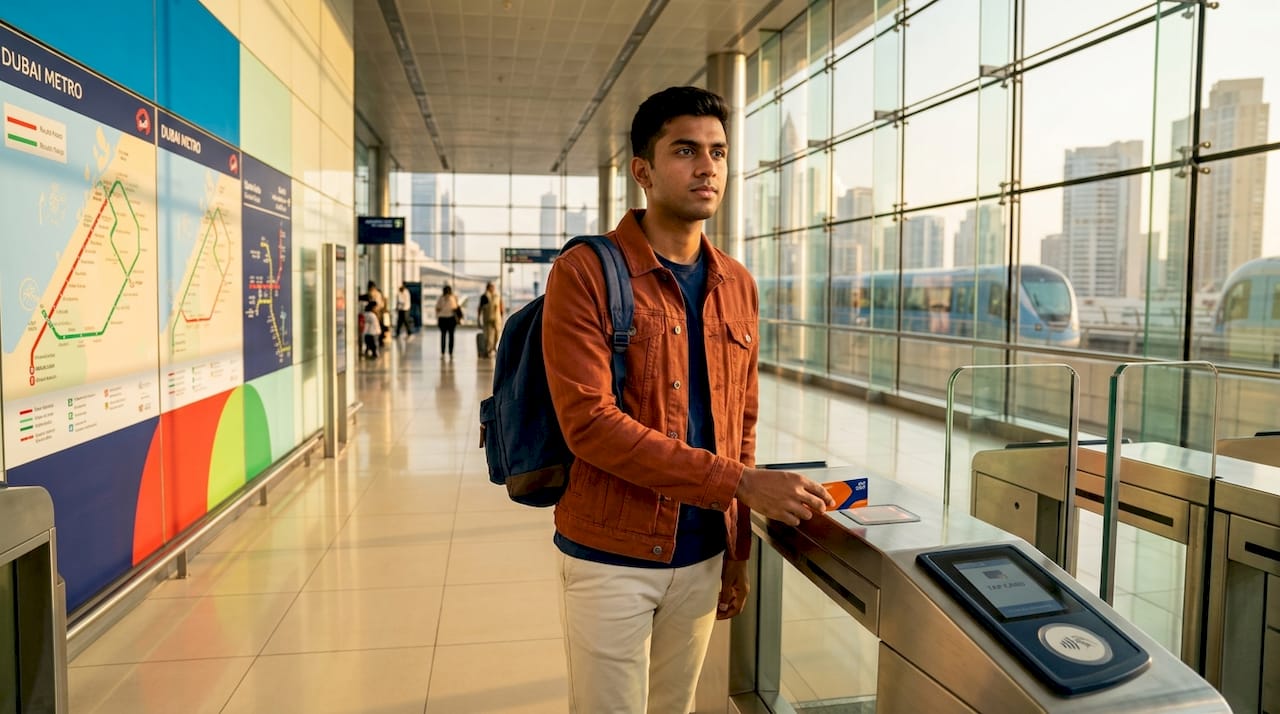
Dubai runs the most developed transit system in the country. The Dubai Metro covers two lines, Red and Green, linking major university zones including Dubai Knowledge Park, Dubai International Academic City, and Dubai Marina. The Dubai Tram connects the Marina area and integrates with the Metro at two interchange stations. Dubai’s bus network covers over 100 routes, and the RTA Water Bus and Abra services connect waterfront areas. All of these accept the NOL card, which is the standard contactless smart card used across Dubai’s transit modes.
Abu Dhabi operates a city bus network managed by AD Mobility, with routes covering the main island, Khalifa City, and key university areas including NYU Abu Dhabi and Khalifa University. Abu Dhabi is also developing a metro system, though it is not yet operational for students in 2026. For now, the bus network is the primary public option, supplemented by taxis and ride-hailing apps.
Sharjah and Ajman share a bus network operated by SRTA (Sharjah Roads and Transport Authority). Several routes connect Sharjah directly to Dubai, which matters because many students live in Sharjah for lower rent while studying in Dubai. Ajman also runs its own city bus service with routes to Sharjah and limited Dubai connections.
Ras Al Khaimah operates city bus routes through RAKTA (Ras Al Khaimah Transport Authority). RAK city buses run every one to one and a half hours with fares between AED 5 and AED 10. This infrequent schedule means students in RAK often rely more heavily on university transport or ride-hailing for time-sensitive trips.
Key transit modes across the UAE at a glance:
- Dubai Metro and Tram (NOL card required)
- RTA buses across Dubai and intercity routes to Sharjah
- Abu Dhabi city buses via AD Mobility
- Sharjah and Ajman SRTA bus network
- RAK city buses via RAKTA
- Water buses and Abra ferries in Dubai
- Careem and Uber as supplementary options across all emirates
How do student discount cards and permits work across different emirates?
Student fare discounts in the UAE are not automatic. You need to apply for the right card in each emirate, and the structure of those discounts varies significantly.
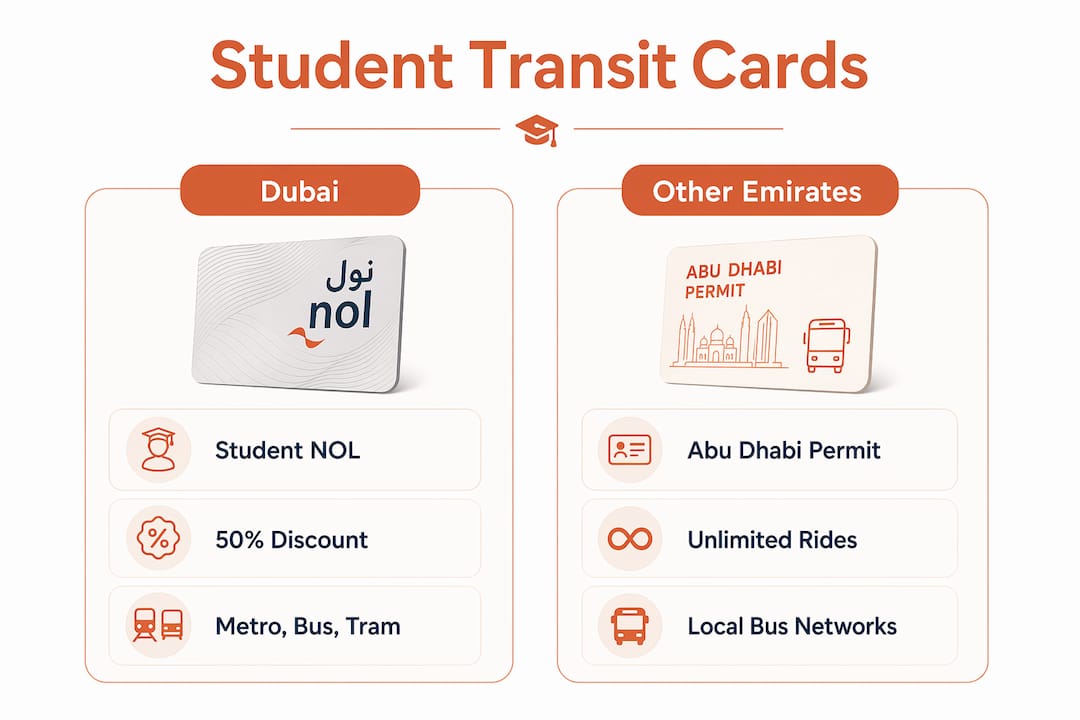
Dubai’s Student NOL Card is the most widely used student transit card in the country. It offers a 50% discount on fares for students aged 5 to 23, covering the Metro, Tram, buses, and water transport. The card costs AED 70 to issue, which includes AED 20 in preloaded credit. It is valid for one year and must be renewed annually. You can also add an ISIC (International Student Identity Card) function to the NOL card for an additional AED 25, which unlocks further retail and service discounts beyond transit.
Abu Dhabi’s student public transport permit works on a completely different model. Rather than a per-trip discount, AD Mobility’s annual permit costs AED 500 and provides unlimited free travel on Abu Dhabi city buses for the full year. This is exceptional value if you commute daily within Abu Dhabi. The permit excludes intercity buses, so trips to Dubai or Sharjah are not covered.
Ajman and Ras Al Khaimah both offer student discount cards for their local bus networks. In RAK, the RAKTA silver card costs AED 20 with AED 10 in credit and delivers a 50% fare reduction on city buses. Note that intercity bus discounts are excluded.
The table below compares the main student transit cards across emirates:
| Card / Permit | Cost | Discount Type | Covered Modes | Intercity Buses |
|---|---|---|---|---|
| Dubai Student NOL Card | AED 70 (incl. AED 20 credit) | 50% per trip | Metro, Tram, Bus, Water | Partial |
| Abu Dhabi Student Permit | AED 500 annually | Unlimited free travel | City buses only | No |
| RAK RAKTA Silver Card | AED 20 (incl. AED 10 credit) | 50% per trip | City buses | No |
| Ajman Student Card | Varies | Discounted fares | City buses | No |
Pro Tip: If you study in Abu Dhabi but visit Dubai regularly, hold both the Abu Dhabi student permit and a Dubai Student NOL Card. The combination of both passes cuts your total transit spend far more than relying on a single card.
What university transportation services are available to students in the UAE?
Several UAE universities operate their own transportation networks, and these services are often free or heavily subsidized. They are one of the most underused resources available to international students.
AURAK (American University of Ras Al Khaimah) runs one of the most extensive university shuttle programs in the country. AURAK provides free daily transportation covering multiple emirates including Dubai and Sharjah, with a weekend service to Abu Dhabi. This is specifically designed for students living off-campus across different emirates. University transport schedules are aligned with academic calendars and lecture times, which reduces transfer wait times and makes time management significantly easier.
The benefits of university-provided transport go beyond cost:
- No need to track public transit schedules during exam periods
- Direct routes from residential areas to campus without transfers
- Late-evening return services that public buses often do not cover
- Reduced exposure to peak-hour crowding on public transit
- Free or minimal cost compared to daily taxi or ride-hailing use
To access university shuttle services, check your institution’s student affairs or transportation office during orientation week. Most universities require a one-time registration with your student ID. Some, like AURAK, operate on a first-come, first-served basis for route capacity, so registering early matters.
University shuttles work best as your primary daily commuter option, with public transit filling the gaps for off-campus errands, weekend travel, or routes the shuttle does not cover.
How to apply for student transportation passes and optimize daily travel?
Getting your student transit cards sorted in the first two weeks of arrival saves you money from day one. Here is the process for the most commonly used cards.
Applying for the Dubai Student NOL Card:
- Gather your documents: a valid enrollment letter from your university, your Emirates ID, and a passport-size photo.
- Apply online through the RTA website or the RTA Dubai app, or visit any RTA customer service center in person.
- Pay the application fee of AED 50 plus AED 20 card credit at the time of submission.
- Allow 10 to 15 days for card delivery if applying online. In-person applications at service centers can be faster.
- Optionally, add the ISIC function for AED 25 to unlock student discounts at retail partners.
Applying for the Abu Dhabi student permit:
- Visit the AD Mobility website or a transit customer service center in Abu Dhabi.
- Submit your university enrollment letter, Emirates ID, and a recent photo.
- Pay AED 500 for the annual permit.
- The permit is typically activated within a few business days.
Daily travel optimization tips:
- Top up your NOL card regularly using the RTA Dubai app, NOL Pay app, or any Metro station top-up machine. Running out of credit at a turnstile wastes time.
- Use Google Maps or the RTA Dubai app to plan routes in real time. Both show live bus and metro schedules.
- For off-hours travel or routes with poor public transit coverage, Careem and Uber operate across the UAE with typical fares between AED 15 and AED 30 for city trips. These are practical for late-night returns or weekend outings.
- Dubai’s Metro provides women-and-children-only cabins as a standard safety feature. Female students should use these during peak hours for added comfort.
- If you have a UAE eSIM or local data plan, keeping transit apps loaded and accessible makes a real difference to daily commuting speed. A reliable UAE eSIM lets you access maps and apps from the moment you land.
Pro Tip: Set a monthly calendar reminder to check your NOL card balance and renewal date. The Student NOL Card expires annually, and a lapsed card means paying full fare until you renew.
Key takeaways
Student transportation in the UAE is most affordable when you combine emirate-specific discount cards with university shuttle services and strategic use of ride-hailing apps for off-peak gaps.
| Point | Details |
|---|---|
| Dubai Student NOL Card | Costs AED 70, gives 50% off Metro, Tram, Bus, and Water transport for students aged 5 to 23. |
| Abu Dhabi annual permit | AED 500 per year for unlimited city bus travel, best value for daily Abu Dhabi commuters. |
| University shuttles | AURAK and similar programs offer free cross-emirate transport aligned with lecture schedules. |
| Combine cards strategically | Holding both a Dubai NOL Card and Abu Dhabi permit maximizes savings for cross-emirate students. |
| Ride-hailing as backup | Careem and Uber fill gaps for off-hours or underserved routes at AED 15 to AED 30 per trip. |
What I’ve learned about student transit in the UAE after years of tracking it
Most international students arrive in the UAE and spend their first month overpaying for transport. They use Careem for everything because it feels easy, and they do not realize the Student NOL Card or university shuttle even exists until a classmate mentions it. That delay costs real money.
The single most effective move any student can make in week one is registering for their university’s shuttle service and applying for the emirate-specific discount card simultaneously. These two steps alone can cut monthly transport costs by more than half compared to relying on ride-hailing.
What I find genuinely underappreciated is the Abu Dhabi unlimited permit. At AED 500 per year, it works out to roughly AED 42 per month for unlimited city bus travel. For a student commuting five days a week, that is an extraordinary deal that most students from outside Abu Dhabi do not even know exists.
Cross-emirate travel is where students often get tripped up. The discount cards in each emirate do not cover intercity routes, so a student living in Sharjah and studying in Dubai needs to understand that their Sharjah bus card and Dubai NOL Card serve different legs of the same journey. Planning that two-card system from the start, rather than discovering it by accident, is the difference between a stressful commute and a predictable one.
My honest advice: treat your first week in the UAE as a logistics week. Get your cards, register for the shuttle, download RTA Dubai and Google Maps, and do one test run of your daily commute before classes start. Students who do this arrive to their first lecture relaxed. Students who skip it spend the first month figuring it out under pressure.
— Jogo
Find your university and plan your commute with Find-my-uni
Choosing the right university in the UAE directly affects your daily commute. A campus in Dubai Knowledge Park sits steps from a Metro station. A campus in Ras Al Khaimah may rely entirely on university shuttles. These are real factors that shape your daily life for years.

Find-my-uni helps international students match with universities in Dubai and Abu Dhabi based on their academic profile, program preferences, and lifestyle needs. The platform’s AI-powered university finder tool accounts for location, campus facilities, and support services, so you can factor in transit access from the start. If you are still deciding where to study, exploring your options on Find-my-uni before committing gives you a clearer picture of what your daily commute will actually look like.
FAQ
What is the cheapest way to travel as a student in Dubai?
The Dubai Student NOL Card is the most cost-effective option, offering a 50% fare reduction on Metro, Tram, buses, and water transport for students aged 5 to 23 at an issuance cost of AED 70.
Can I use one student transit card across all UAE emirates?
No. Each emirate operates its own transit system and discount card. The Dubai Student NOL Card covers Dubai’s network, while Abu Dhabi, Sharjah, Ajman, and RAK each have separate cards or permits that apply only within their own networks.
How long does it take to get a Student NOL Card in Dubai?
Online applications take approximately 10 to 15 days for card delivery. Applying in person at an RTA customer service center is typically faster.
Do UAE universities provide free transportation for students?
Some do. AURAK provides free daily shuttle services covering Dubai, Sharjah, and Abu Dhabi for its students. Check with your specific university’s student affairs office during orientation for available routes and registration.
Are ride-hailing apps reliable for student travel in the UAE?
Careem and Uber operate across all major UAE emirates and are reliable for off-hours or underserved routes. Typical fares run AED 15 to AED 30 for city trips, making them a practical supplement to public transit rather than a daily replacement.