Essential guide: How to counsel students for Dubai admissions

TL;DR:
- Early, structured counseling improves students’ chances of securing Dubai university placements.
- Meeting specific academic, language, and document requirements tailored to each institution is crucial.
- Authentic storytelling highlighting UAE multicultural experience helps students stand out to admissions panels.
Helping a student navigate Dubai university admissions without a clear plan is like arriving at a destination without a map. Requirements vary by institution, deadlines sneak up fast, and international students often face an additional layer of complexity around visa paperwork, language proficiency tests, and cultural unfamiliarity. The good news is that structured, early counseling consistently transforms that confusion into real acceptances. This guide walks through every critical stage, from decoding entry requirements to post-submission support, so you can give students the best possible shot at securing a place at a Dubai university that fits their goals.
Table of Contents
- Understanding Dubai university admission requirements
- Key steps for counseling students: Early preparation to application
- Common challenges and how to avoid them
- Verifying success: Final checks and ongoing support
- Our take: Why great counseling is more than admissions checklists
- Take the next step with Dubai admissions support
- Frequently asked questions
Key Takeaways
| Point | Details |
|---|---|
| Start counseling early | Begin student guidance by Grade 10 to ensure competitive applications. |
| Know all requirements | Understand Dubai university criteria from transcripts to tests before you start. |
| Avoid common mistakes | Prioritize authenticity and careful planning in every application step. |
| Support beyond submission | Counsel students through final checks, interview prep, and offer selection. |
Understanding Dubai university admission requirements
Before you can guide a student effectively, you need to know exactly what Dubai universities expect. Requirements differ quite a bit depending on whether a student is applying for an undergraduate or postgraduate program, so let’s break both down clearly.
Undergraduate requirements at a glance:
- High school diploma with a minimum of 75 to 80 percent in Class 12
- EmSAT or SAT scores (subject minimums vary by program and institution)
- English proficiency: IELTS 6.0 or equivalent (TOEFL scores are also accepted at many campuses)
- Personal statement (required by select programs and institutions)
- Passport copy and completed application form
Postgraduate requirements at a glance:
- Bachelor’s degree with a CGPA of at least 3.0 out of 4.0
- Updated English proficiency proof (IELTS or TOEFL)
- Statement of purpose (SOP) and two to three professional or academic references
- Relevant work experience (required for MBA and some specialized master’s programs)
As outlined in the official admissions policies, undergraduate admissions typically require a high school diploma with 75 to 80 percent, EmSAT or SAT scores, and IELTS 6.0 or above, while postgraduate programs expect a bachelor’s CGPA of 3.0 or better, along with an SOP and references.
Dubai’s university landscape includes branch campuses of globally ranked institutions alongside home-grown universities, and each has slightly different thresholds. For example, a technology-focused program may require a higher EmSAT math score, while a business program may weight the personal statement more heavily.
| Requirement | Undergraduate | Postgraduate |
|---|---|---|
| Academic benchmark | 75-80% in Class 12 | CGPA 3.0/4.0 |
| English proficiency | IELTS 6.0+ | IELTS 6.5+ |
| Standardized test | EmSAT/SAT | Not typically required |
| SOP/Personal statement | Selected programs | Usually required |
| References | Rare | 2-3 required |
You can explore Dubai university eligibility criteria across multiple institutions in one place, which saves significant research time.
Pro Tip: Always check the specific requirements page for each university your student is targeting. Blanket assumptions based on general rules can lead to missing a program-specific document or score threshold.
Key steps for counseling students: Early preparation to application
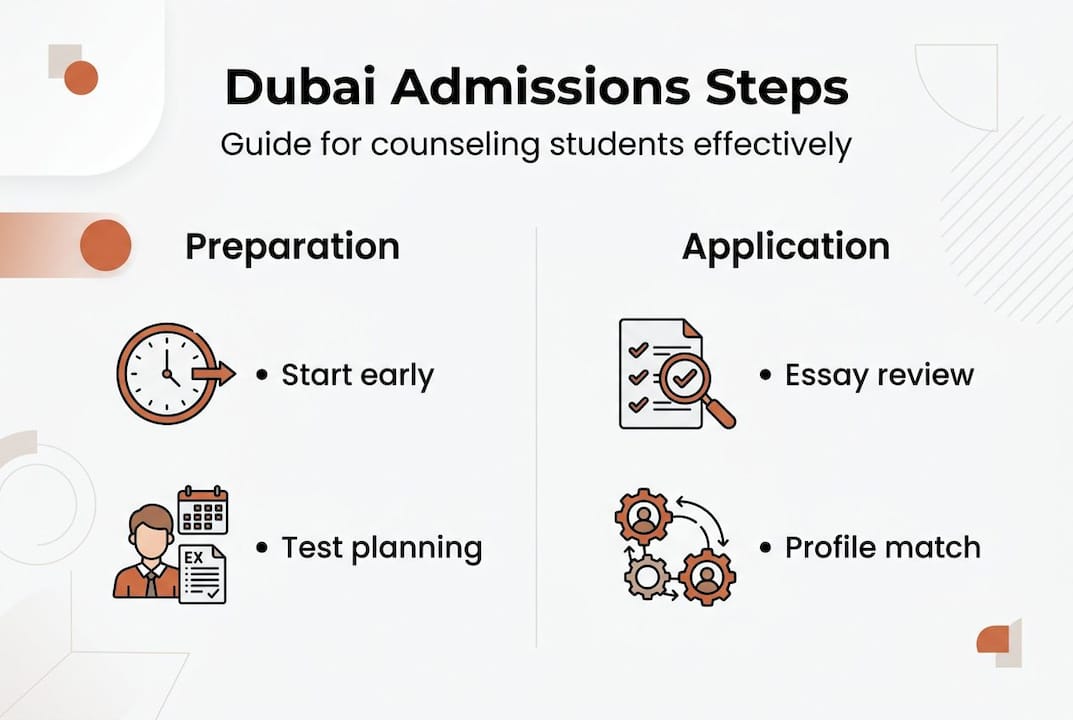
Effective counseling is not a last-minute sprint. The most successful students start working with counselors well before their graduation year. Research suggests that guidance starting in Grade 10 using platforms like Unifrog for career exploration and building extracurricular activities consistently produces stronger outcomes than late-stage intervention.
Here is a practical sequence to follow:
- Self-assessment (Grade 10 or Year 10): Help students identify academic strengths, career interests, and personal goals. This shapes every decision that follows.
- Career and program exploration (Grade 11): Use digital tools and counselor sessions to narrow down fields of study. Unifrog, career aptitude assessments, and job-shadowing can all feed into this stage.
- Document collection (Grade 11 to early Grade 12): Gather transcripts, identification documents, and teacher recommendation letters before deadlines approach.
- Test preparation (Grade 11 to Grade 12): Register and prepare for EmSAT, SAT, IELTS, or TOEFL well in advance. Students who sit these exams early leave room for a retake if needed.
- University shortlisting (mid-Grade 12): Narrow down to five to eight institutions based on program fit, scholarship availability, and campus culture.
- Application submission (late Grade 12): Submit all materials before rolling deadlines close. Many Dubai universities operate on a first-come, first-served intake model.
Need a clear starting point? Review the Dubai application steps that align with each phase of a student’s academic calendar.
| Factor | Early start (Grade 10) | Late start (Grade 12) |
|---|---|---|
| Test retake opportunities | Multiple | One or none |
| Essay quality | Polished, authentic | Rushed, generic |
| Scholarship eligibility | Strong | Limited |
| Stress level | Manageable | High |
| Offer likelihood | Higher | Reduced |
Pro Tip: Encourage students to keep a shared digital folder from Grade 10 onward. Storing scanned documents, test registration receipts, and draft essays in one place prevents the frantic last-minute search that derails many applications.
Common challenges and how to avoid them
Even well-prepared students stumble. Understanding where things go wrong lets you intervene before a small mistake becomes a costly rejection.
The top five challenges counselors see repeatedly:
- Late start: Students who begin preparing in their final semester miss early-bird scholarship windows and have less time for test retakes.
- Missing tests or documents: A forgotten EmSAT registration or an unsigned reference letter can hold up an entire application for weeks.
- Generic, inauthentic essays: Admissions officers in Dubai read thousands of personal statements. Vague, template-driven writing stands out for all the wrong reasons.
- Ignoring financial planning: Tuition fees, visa costs, and living expenses in Dubai can surprise families who haven’t budgeted early. Overlooking this leads to last-minute withdrawals after acceptance.
- Failing to highlight UAE relevance: Dubai universities value students who understand and can contribute to the region’s multicultural, fast-growing environment.
One of the clearest pieces of critical mistakes to avoid comes from admissions experts who work directly in the UAE:
“Prioritize authenticity over AI-generated content. Integrate affordability planning early. For students applying to Dubai universities, highlight UAE experiences like multicultural leadership in your applications.”
That last point is particularly important. A student who has volunteered in a multicultural community, led a school team with peers from ten different countries, or completed an internship in the Gulf region has a compelling angle that generic applicants simply cannot replicate. Part of your role as a counselor is to draw those experiences out and help students articulate them clearly.

When you are matching Dubai admissions criteria with a student’s actual profile, you will find that small adjustments to how a story is told can make a measurable difference in outcomes.
Verifying success: Final checks and ongoing support
Submitting the application is not the finish line. Comprehensive counseling extends through verification, interview preparation, and the transition to student life in Dubai.
Pre-submission checklist:
- Confirm all academic transcripts are certified and properly translated if required
- Verify that standardized test scores have been sent directly to the university
- Review essays and SOPs for authenticity, clarity, and relevance to the chosen program
- Confirm that reference letters are sealed, signed, and submitted by the deadline
- Double-check passport validity (most universities require at least six months remaining)
According to the admission checklist published by the University of Dubai for 2025 to 2026, postgraduate applicants need a verified bachelor’s degree with a CGPA of 3.0 or above, along with English proficiency proof and an SOP. Catching any of these gaps before the deadline prevents rejection on technical grounds rather than academic ones.
Post-submission steps to support:
- Interview preparation: Many programs, especially MBA and law, require a face-to-face or video interview. Run mock sessions with your student.
- Offer comparison: Help students weigh scholarship packages, campus resources, and career outcomes before committing.
- Visa processing: Guide students through the UAE student visa requirements, including the health insurance mandate and Emirates ID registration.
- Arrival logistics: Connect students with housing resources and orientation programs so they arrive settled, not scrambling.
Students who complete the final Dubai admissions checklist with all materials submitted on time significantly improve both their acceptance rate and their chances of receiving merit-based financial support.
Statistic callout: Students who submit complete, verified application packages before rolling deadlines close are considerably more likely to receive conditional or unconditional offers within the first intake cycle, compared to those who apply in the final weeks.
Our take: Why great counseling is more than admissions checklists
Here is something the standard counseling guides rarely say out loud: checklists do not get students into great programs. Students get themselves in, and the counselor’s real job is to help them tell an honest, vivid story that resonates with an admissions panel.
Dubai’s academic environment is genuinely multicultural. Institutions here interact daily with students from South Asia, the Arab world, East Africa, Europe, and beyond. That context means a student who can articulate how they’ve grown through cross-cultural experiences, navigated language differences, or led in diverse teams has a qualitative edge that a higher test score alone cannot produce.
We have seen students with average academic benchmarks secure strong program offers because their personal statements captured something real, something that made an admissions reader pause. We have also seen high-achieving students receive rejections because their essays read like a list of accomplishments rather than a genuine reflection.
The shift we advocate for is moving from seasonal, deadline-triggered counseling toward year-round, student-driven conversations. Check in during summer. Ask students what they are reading, what problems interest them, what they are noticing in the world around them. That ongoing dialogue produces the raw material for essays that actually stand out in a competitive Dubai admissions pool.
Take the next step with Dubai admissions support
Navigating Dubai admissions alone is overwhelming, but it does not have to be. Whether you are a student trying to figure out where to start or you are already deep in the process and need clarity on next steps, having the right support structure changes everything.
At Find My Uni, we connect international students with programs and institutions that genuinely fit their academic profiles, using a personalized AI matching system built specifically for the UAE market. From program discovery to visa guidance and arrival support, our team walks alongside you at every stage. Speak with a personal Dubai admissions counselor today and start building the application that gets you where you want to go.
Frequently asked questions
What academic qualifications are required for undergraduate admissions to Dubai universities?
A high school diploma with at least 75 to 80 percent in Class 12, along with EmSAT or SAT scores and IELTS 6.0 or above, are the standard requirements at most Dubai universities.
When should students and counselors start preparing for Dubai admissions?
The ideal starting point is Grade 10 or Year 10, which gives students enough time for test preparation, career exploration, extracurricular development, and polished essay writing before final-year deadlines.
What is the most common mistake in Dubai university applications?
Submitting generic or AI-generated essays ranks among the top errors. Admissions reviewers in Dubai consistently flag inauthentic essay content as a primary reason for weak or rejected applications.
How can counselors help students stand out in Dubai admissions?
Encourage students to highlight specific UAE multicultural experiences, such as cross-cultural leadership or community involvement in diverse settings, which resonate strongly with Dubai admissions panels.