How degree recognition works in the UAE: A step-by-step guide

TL;DR:
- The UAE’s degree recognition process has become faster, simpler, and now requires only four documents.
- Recognition is essential for employment, licensing, and further education in the UAE, with processing taking 18 to 30 days.
- Verifying accreditation, matching names on all documents, and avoiding online credit overload are key to successful recognition.
The UAE’s degree recognition process has quietly become one of the most efficient in the region, and most students don’t know it yet. Recent policy updates have slashed the rejection rate from 8.3% to 3.5% and cut required documents from 14 down to just 4. If you’ve been holding back on your UAE academic or career plans because you assumed the process was a bureaucratic maze, that assumption is outdated. Recognition is faster, simpler, and more accessible than ever before, and understanding exactly how it works puts you ahead of most applicants right from the start.
Table of Contents
- What is degree recognition and why does it matter in the UAE?
- Step-by-step: The UAE degree recognition process in 2026
- Key criteria: What qualifications are (and are not) recognized
- What most students miss: Simplification, edge cases, and winning strategies
- A fresh perspective: Why degree recognition is getting easier—but not risk-free
- Ready for recognition? Let’s help you succeed
- Frequently asked questions
Key Takeaways
| Point | Details |
|---|---|
| Faster, easier process | Degree recognition in the UAE now takes fewer documents and less time than before. |
| Online degrees allowed—with limits | Distance and online learning are accepted only within certain credit and program guidelines. |
| Prepare documents carefully | Successful recognition depends on accredited degrees and accurate documentation. |
| Edge cases need extra checks | If your degree is from a non-traditional source, pre-verify and address any potential issues up front. |
What is degree recognition and why does it matter in the UAE?
Degree recognition is the official process by which the UAE government validates a foreign academic qualification and confirms it meets local academic standards. It’s not a formality. Without it, your degree simply does not count in most official contexts inside the country.
The Ministry of Education handles the evaluation process through its dedicated credential assessment framework. When your foreign degree is recognized, it becomes legally valid for employment, professional licensing, and enrollment in UAE-based graduate programs. Without that stamp of approval, even a prestigious international degree can leave you stuck.
Here’s what’s actually at stake if your degree goes unrecognized:
- Job offers can be withdrawn because employers are legally required to verify recognized credentials for certain roles.
- Professional licenses are blocked, particularly in regulated fields like medicine, law, engineering, and education.
- Graduate school enrollment is denied if the degree that qualifies you hasn’t been officially verified.
- Certain residency and visa categories tied to academic employment require recognized qualifications.
As Gulf News reports, recognition is required for all foreign university degrees used for legal work, professional licensing, and further education in the UAE.
“Degree recognition isn’t just administrative paperwork. It’s the bridge between your international education and your UAE future.”
The good news is that recent reforms have aligned the recognition process with the UAE’s Zero Bureaucracy program, which aims to remove unnecessary steps from all government services. For students and graduates, this means how degree recognition works today looks very different from what it did even two years ago. Less paperwork, cleaner timelines, and fewer reasons to get stuck.
Step-by-step: The UAE degree recognition process in 2026
With the importance of recognition in mind, here’s a clear breakdown of exactly how the process works in 2026.
The Ministry of Education manages applications through its online portal. Here’s the process in order:
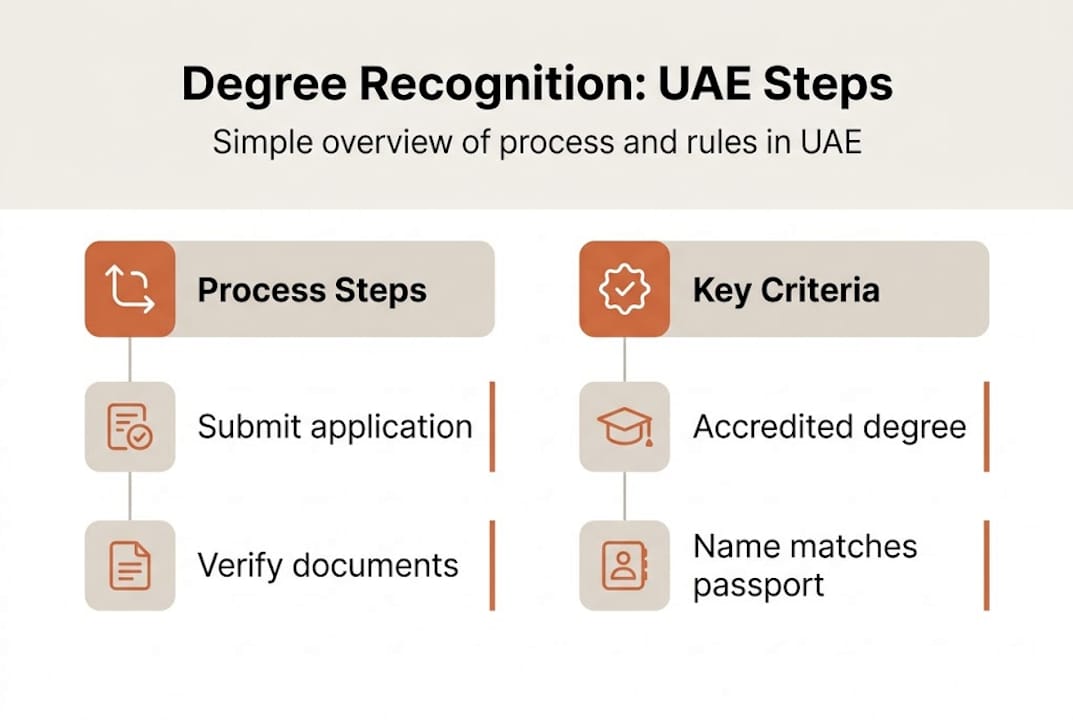
- Prepare your documents. Gather the four required items: your original degree certificate, official transcripts, a copy of your passport, and a university verification report from your institution.
- Create an account on the Ministry’s portal and select the degree recognition service.
- Upload and submit your documents in the required format. Originals or certified digital copies are accepted.
- Pay the application fee, which varies by degree level (see table below).
- Wait for processing. The Ministry reviews your application, contacts your institution for verification if needed, and issues a decision.
- Receive your outcome. Approved applicants get an official recognition certificate. Rejected applicants receive a reason and can appeal or resubmit.
As noted in recent reporting, required documents have been reduced to just 4 basic items, down from a previous list of more than 14.
| Degree level | Application fee (AED) | Processing time |
|---|---|---|
| Bachelor’s | 300 | 18 to 30 working days |
| Master’s | 400 | 18 to 30 working days |
| Doctoral (PhD) | 500 | 18 to 30 working days |
The processing time of 18 to 30 working days applies after all documents are received and verified as complete. Incomplete submissions or documents that require additional verification from overseas institutions are the primary reasons for delays.

Pro Tip: Make sure your name on your degree certificate exactly matches your passport. Even a middle name discrepancy can stall your application by weeks.
If you’re still in the process of finding a UAE university before graduation, check whether your current institution is listed in recognized accreditation databases. Starting that check early saves time later.
Key criteria: What qualifications are (and are not) recognized
Knowing the process is just one part; understanding what qualifications actually pass is equally vital.
Not every degree from every institution qualifies for recognition in the UAE. The system evaluates both the institution and the program itself. Here’s how accepted and non-accepted scenarios compare:
| Qualification type | Recognition status | Notes |
|---|---|---|
| Degree from an accredited university | Accepted | Must have national or regional accreditation |
| Online degree, credit load within limits | Conditionally accepted | No more than 18 credits per semester |
| Online degree, heavy distance loading | Likely rejected | Exceeds allowed online credit thresholds |
| Vocational or trade certificate | Not recognized | Falls outside university degree definition |
| Degree from non-accredited institution | Rejected | No exceptions |
| Incomplete degree or partial credits | Not recognized | Degree must be fully conferred |
According to updated UAE policy, online degrees are allowed with conditions, including a cap of no more than 18 online credits per semester, and are excluded entirely for certain specialized professions. Vocational certifications, no matter how reputable, typically fall outside the scope of what the Ministry evaluates.
The most common pitfalls that lead to rejection include:
- Unaccredited institutions that issue degrees without national or regional approval
- Name mismatches between your academic records and your passport
- Excessive online or distance study beyond permitted limits
- Missing or improperly certified documents, especially the verification report
- Programs from institutions not recognized by their own home country’s education authority
While edge case rejection rates are falling, these scenarios still account for most denials. Checking your degree eligibility for UAE before you apply is one of the most practical steps you can take.
What most students miss: Simplification, edge cases, and winning strategies
Having seen what qualifies, it’s time to understand the latest breakthroughs and the smart moves you can make before applying.
The scale of recent reform is worth pausing on. The Ministry’s simplification drive has cut document requirements by 70%, and the number of students successfully receiving recognition has doubled as a result. That’s a structural shift, not a minor update.
But here’s what most guides don’t tell you: simplification doesn’t protect you from edge case traps. Students who assume a smoother process means a less rigorous one are the ones who run into problems. Distance learning limits, unaccredited sources, and name discrepancies haven’t disappeared. They’ve just become a larger share of the remaining rejections.
Here are four strategies that give you the best shot at a clean, fast approval:
- Run a pre-verification check before formally submitting. Contact your university to confirm they can produce a proper verification report. Some institutions have slow administrative timelines that delay your UAE application.
- Download your institution’s accreditation proof from your home country’s education ministry or the relevant regional body. Having this ready prevents the Ministry from needing to conduct its own external check.
- Match your name consistently across every document you submit. Passport, degree, transcripts, and ID should all read identically.
- Avoid submitting during peak intake seasons (typically September and January). Processing volumes spike and informal timelines can stretch.
Pro Tip: If your degree has any online components, calculate your per-semester credit hours before applying. Submitting without that check, and having it flagged, can add weeks to your timeline.
For students exploring their options before making a final decision, reviewing UAE degree recognition tips early in the process means fewer surprises later.
A fresh perspective: Why degree recognition is getting easier—but not risk-free
The reforms are real and they matter. A 70% reduction in document requirements is not a rounding error. It reflects a genuine policy shift toward treating international students and graduates as valuable contributors to the UAE’s academic and professional ecosystem. That’s worth recognizing.
But here’s our honest take: the biggest risk we see isn’t the process itself. It’s overconfidence. Students who read about simplification and assume their case is straightforward often skip the pre-verification step. They submit without double-checking their institution’s accreditation status or reviewing their online credit breakdown. And then they’re blindsided by a rejection that was entirely preventable.
The new landscape rewards students who combine the benefit of simplified rules with disciplined preparation. Pre-verification isn’t bureaucratic caution. It’s the single most effective thing you can do to protect your timeline and your plans. The students who succeed fastest aren’t just lucky. They prepare smarter.
Ready for recognition? Let’s help you succeed
Navigating degree recognition is cleaner than it used to be, but it still requires knowing where to look and what to prepare. At Find My Uni, we work specifically with international students who want to make their qualifications count in the UAE.

Our University Finder Dubai tool matches you with accredited programs that align with your academic background, so you can be confident your future degree will meet UAE recognition standards from day one. Whether you’re still choosing your university or already planning your recognition application, our advisors are ready to help you move forward with clarity and confidence.
Frequently asked questions
How long does degree recognition take in the UAE?
Most degrees are processed within 18 to 30 working days after complete documents are submitted. Delays typically happen when institution verification takes extra time.
What documents are required for degree recognition?
You need your original degree and transcripts, a passport copy, and an official university verification report. The list was recently reduced from over 14 items to just these four.
Are online or distance learning degrees recognized in the UAE?
Yes, under specific conditions. Online credits must not exceed 18 per semester, and online degrees are not accepted for certain specialized professions like medicine or law.
What are the common reasons for rejection of degree recognition?
The most frequent causes include unaccredited institutions and name mismatches, along with missing documents and exceeding the permitted threshold for distance learning credits.