Why UAE universities lead in global success: 42K+ enrolled
TL;DR:
- Dubai’s private universities experienced a 20% enrollment increase in 2024-25, attracting more international students.
- The UAE offers a safe, multicultural environment with streamlined visas and tax-free income for students.
- Recognized UAE universities align with global standards, providing strong career prospects within a growing international education system.
Most parents automatically picture London or New York when their child mentions studying abroad. That picture is changing fast. Dubai’s private universities enrolled 42,026 students in 2024-25, a 20% jump year-over-year, with international students growing by 29%. Those are not the numbers of a niche destination. They reflect a serious, government-backed education system that is drawing families away from traditional Western options. This guide walks you through the facts, the real-world advantages, and the honest challenges so you can decide whether the UAE deserves a place on your shortlist.
Table of Contents
- The UAE’s global education surge: Numbers and strategy
- Why families are choosing UAE: Safety, ROI, and cultural experience
- Recognized quality: Accreditation, rankings, and future prospects
- Common concerns: Addressing the challenges honestly
- The bigger picture: What most families overlook about studying in the UAE
- Ready to explore UAE universities for your child?
- Frequently asked questions
Key Takeaways
| Point | Details |
|---|---|
| Global enrollment growth | The UAE is attracting international students at unprecedented rates, reflecting its rising academic reputation. |
| Safe and multicultural | UAE universities offer secure environments and vibrant, diverse student communities ideal for global-minded youth. |
| Strong career prospects | Accredited UAE degrees are recognized worldwide and open doors to internships and tax-free careers. |
| Family-friendly considerations | Parents can expect competitive costs, robust safety, and transparent pathways for their children’s success. |
The UAE’s global education surge: Numbers and strategy
The UAE’s rise in higher education is not accidental. It is the result of deliberate investment, clear policy goals, and a government that treats education as a national priority.
On raw numbers alone, the story is striking. 57,035 new students enrolled in UAE higher education institutions in 2024-2025, the highest intake in a decade, representing a 13% increase over the previous year. Females made up 54% of that cohort, signaling a genuinely inclusive environment. These are not vanity statistics. They reflect a system that is expanding its capacity to serve a global student population.
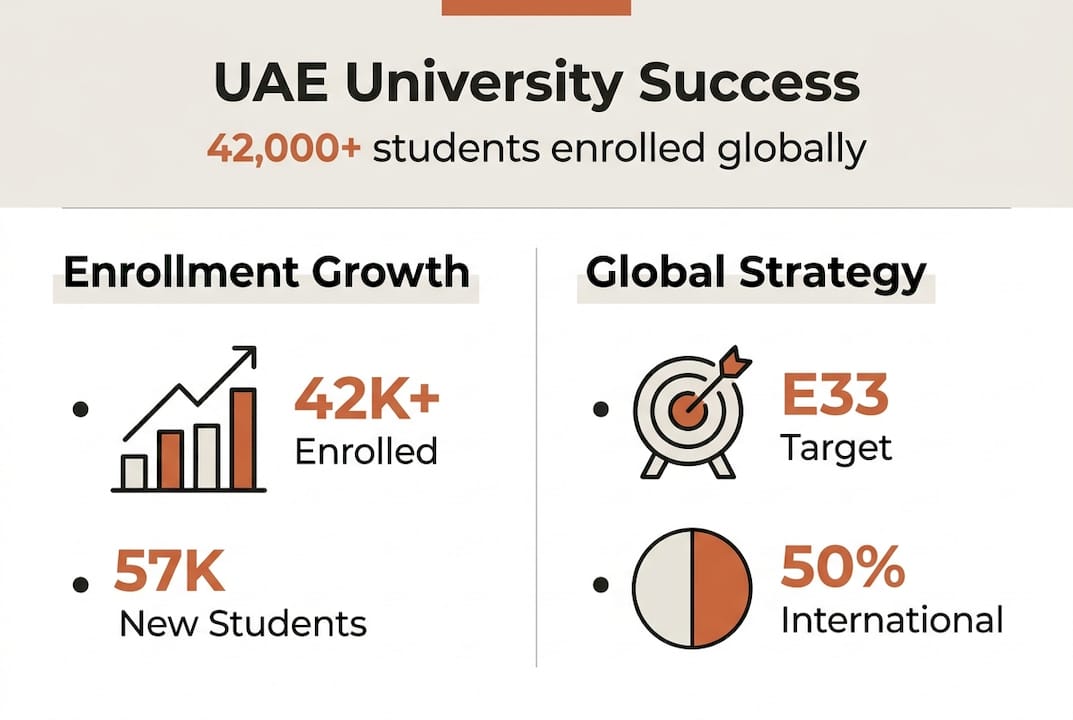
The policy engine behind this growth is the UAE’s E33 strategy, a long-term national plan that targets making the UAE one of the top 10 countries globally across economic and social indicators. Within education, the UAE education strategy includes a specific goal of reaching 50% international student enrollment across higher education institutions. That target drives real spending on faculty, facilities, and student services.
| Metric | 2023-24 | 2024-25 | Change |
|---|---|---|---|
| Total Dubai private HE enrollment | ~35,000 | 42,026 | +20% |
| International student share | ~27% | 35% | +29% |
| National new HE intake | ~50,000 | 57,035 | +13% |
| Female student share of new intake | ~52% | 54% | +2pp |
“Dubai’s private school sector now benchmarks in the top 14 globally on PISA-equivalent assessments, a signal that the pipeline feeding its universities is genuinely strong.”
For parents, this matters beyond headline numbers. A growing, well-funded system attracts better faculty, newer research facilities, and stronger industry partnerships. The Dubai university landscape today looks very different from even five years ago, and the trajectory is still pointing upward.
Why families are choosing UAE: Safety, ROI, and cultural experience
Data tells part of the story. But most parents make decisions based on gut-level concerns: Is my child safe? Will this degree pay off? Will they thrive socially?
On safety, the UAE consistently ranks among the world’s lowest-crime environments. Dubai’s multicultural community, home to over 200 nationalities, creates a campus culture that is welcoming rather than isolating for international students. This stands in sharp contrast to the social friction that some international students report in Western cities.

On cost and value, the comparison is more nuanced. Visa tightening in the UK and US has made those destinations harder to access and, in some cases, less welcoming. The UAE offers a smoother visa process for many nationalities, and the absence of income tax means internship earnings go further.
| Factor | UK/US | UAE |
|---|---|---|
| Safety ranking | Varies by city | Consistently top-tier |
| Visa complexity | High, tightening | Streamlined for students |
| Income tax on internships | Yes | None |
| Cultural diversity on campus | Moderate to high | Exceptionally high |
| Post-study work rights | Limited/complex | Growing pathways |
Key advantages that parents frequently cite when finding UAE universities for their children:
- No income tax on part-time work and internships, so students keep more of what they earn
- Year-round sunshine and a modern city infrastructure reduce daily stress
- Proximity to Asia, Africa, and Europe makes travel home more affordable for many nationalities
- English-taught programs at most international universities remove language barriers
Pro Tip: Many families assume Dubai is always more expensive than studying in the UK or US. Tuition fees at UAE universities are often comparable or lower, and when you factor in tax-free internship income, the total cost equation frequently tilts in the UAE’s favor. Always compare total cost, not just tuition.
Recognized quality: Accreditation, rankings, and future prospects
A degree is only as valuable as the institutions and employers that recognize it. This is where the UAE has made some of its most impressive strides.
Several UAE universities now carry international accreditation from bodies recognized in the US, UK, and Europe. Institutions like NYU Abu Dhabi, the University of Birmingham Dubai, and Heriot-Watt University Dubai operate under the same academic standards as their home campuses. That means a degree earned in Dubai carries the same weight as one earned in Edinburgh or New York.
Beyond branch campuses, homegrown UAE institutions are climbing global QS rankings at a pace that surprises most observers. The E33 strategy’s explicit target is to place UAE institutions firmly in top-tier global rankings, and government investment is making that goal realistic rather than aspirational.
Career outcomes are where the picture gets genuinely exciting. The UAE’s position as a global business hub means students are not just studying near opportunity. They are inside it. Internships with multinational companies based in Dubai Media City, Dubai International Financial Centre, and Abu Dhabi Global Market are accessible in ways that simply are not possible in smaller university towns.
Companies actively recruiting UAE graduates include:
- PwC, Deloitte, and KPMG (finance and consulting)
- Emirates and Etihad (aviation and logistics)
- Amazon, Microsoft, and Google (regional tech hubs)
- Majid Al Futtaim and Emaar (retail, real estate, hospitality)
Key stat: The E33 strategy targets 50% international student enrollment, signaling that UAE universities are being built explicitly for global talent, not just local demand. For parents evaluating UAE university rankings and career outcomes, that long-term intent matters.
Common concerns: Addressing the challenges honestly
A balanced decision requires looking at the drawbacks too. The UAE is not the perfect fit for every student or family, and pretending otherwise would not serve you well.
The most common genuine concerns are:
Cost of living: Dubai in particular is an expensive city. Accommodation, dining, and lifestyle costs can add up quickly if not managed well. Students who live on campus and cook regularly report much more manageable budgets than those who treat every weekend as a luxury experience.
Climate: Summers in the UAE are genuinely harsh, with temperatures exceeding 40°C (104°F) from June through September. Most universities schedule breaks or minimize outdoor activities during this period, but students who struggle in heat need to factor this in seriously.
Cultural adjustment: The UAE has a distinct social and legal framework. Behaviors that are unremarkable in Western countries can carry legal consequences here. Students need proper orientation before arrival.
Practical steps to prepare your child for studying in the UAE:
- Research visa requirements specific to your nationality at least six months before the intake date
- Compare on-campus versus off-campus housing costs and security before committing
- Review the university’s orientation program to ensure it covers local laws and cultural norms
- Budget for summer travel home or a cooler climate break, since July and August can be difficult for students not accustomed to heat
- Confirm accreditation is recognized in your home country if your child plans to return after graduating
Pro Tip: Many families worry about hidden study costs in Dubai. Ask universities directly for a total annual cost breakdown including housing, health insurance, and mandatory fees. Reputable institutions provide this transparently. If they do not, that is itself a signal worth noting.
The UAE may not be the right choice if your child is set on a very specific niche academic program not yet available there, prefers a traditional Western campus social culture, or struggles significantly with heat. Honest self-assessment prevents costly disappointment.
The bigger picture: What most families overlook about studying in the UAE
Most parents compare universities by prestige label. Oxford versus a UAE institution sounds like an obvious call. But prestige labels are a lazy shortcut, and they cost families real opportunity.
What parents rarely weigh is the network effect of studying in the UAE. A student who spends four years in Dubai is not just earning a degree. They are building relationships across 200 nationalities, interning inside one of the world’s most active business environments, and developing a fluency in cross-cultural communication that is genuinely rare.
In a global job market that increasingly values adaptability and international exposure, that experience is worth more than many people realize. The UAE education guide we have built reflects this reality, connecting students with programs that match both academic goals and career ambitions.
The uncomfortable truth is that a graduate from a well-ranked UAE university with two strong internships at Dubai-based multinationals will often outperform a graduate from a mid-tier UK or US school with no relevant work experience. The degree is one data point. What surrounds it matters just as much.
Ready to explore UAE universities for your child?
If the UAE is now on your radar, the next challenge is narrowing down which university and program actually fits your child’s academic profile and long-term goals. That is harder than it looks, with over 70 accredited institutions across Dubai and Abu Dhabi offering hundreds of programs.
Find My Uni’s AI-powered platform makes this process genuinely manageable. You can find UAE universities that match your child’s grades, preferred field, budget, and career aspirations in minutes rather than weeks of manual research. The platform also covers admission support, visa guidance, and housing options so you have everything in one place.
Frequently asked questions
Are degrees from UAE universities recognized internationally?
Yes, many UAE universities hold international accreditation from bodies recognized globally, and several institutions rank in top QS tiers, making their degrees accepted by employers and academic institutions worldwide.
How safe is it for international students to study in Dubai and the UAE?
Dubai and the UAE are consistently ranked among the safest environments for students globally, with low crime rates and a multicultural community. Experts highlight safety as a key reason students prefer UAE over Western alternatives.
What is the gender balance among students at UAE universities?
In 2024-2025, 54% of newly admitted UAE higher education students were female, reflecting an inclusive and balanced campus environment.
How do costs in the UAE compare to the UK or US?
The UAE often provides comparable or lower tuition fees alongside tax-free internship income, meaning the total financial picture can be more favorable. However, Dubai living costs require careful budgeting, so always compare total annual expenses rather than tuition alone.