How university rankings shape study choices in the UAE

TL;DR:
- University reputation heavily influences international student decisions and recognition in the UAE.
- Rankings mainly measure research, reputation, and subject categorization, not teaching quality or student experience.
- Use rankings as a starting point, but prioritize program relevance, accreditation, and personal goals.
University rankings carry more weight than most students realize. Empirical research shows that university reputation is the dominant factor in international student mobility, with a beta coefficient of 0.673 across 50 countries. That’s not a small nudge. That’s the single strongest predictor of where students choose to study. Yet rankings are also widely misunderstood. Many students treat them as a definitive quality score, when in reality they measure a very specific set of criteria that may or may not match your personal goals. This article breaks down what rankings actually measure, how they shape decisions in the UAE, where they fall short, and how to use them wisely.
Table of Contents
- What university rankings really measure
- How rankings influence student choices in the UAE
- The limitations and biases of university rankings
- Making university rankings work for you: Practical strategies
- Why rankings alone aren’t enough: A fresh perspective
- Find your ideal UAE university with expert tools
- Frequently asked questions
Key Takeaways
| Point | Details |
|---|---|
| Rankings drive mobility | University rankings are the strongest predictor of international student enrollment, especially relevant in the UAE. |
| Understand biases | Ranking systems have inherent biases and flaws, including reputational feedback and research emphasis. |
| UAE uses rankings | The UAE officially recognizes degrees based on global rankings, varying by field and destination country. |
| Compare systems smartly | Always check multiple ranking sources, their methodologies, and local requirements before making a decision. |
| Fit matters most | Personal and academic fit should guide your program selection, not just ranking scores. |
What university rankings really measure
Rankings look authoritative. A numbered list of universities feels like a clear answer to a complicated question. But before you trust that list, you need to understand what’s actually being counted.
The four most influential global ranking systems are QS World University Rankings, Times Higher Education (THE), Academic Ranking of World Universities (ARWU), and US News Global Universities. Each one uses a different formula, and those formulas shape very different outcomes.
Here’s a quick comparison of what each system prioritizes:
| Ranking system | Key metrics | Strength |
|---|---|---|
| QS | Academic reputation, employer reputation, citations per faculty | Strong for career-focused students |
| THE | Teaching, research, citations, industry income, international outlook | Balanced across multiple dimensions |
| ARWU | Nobel laureates, highly cited researchers, research output | Best for research-intensive programs |
| US News | Global research reputation, publications, citations | Useful for graduate-level research |
The critical issue is that rankings primarily measure reputation and research performance, and subject mapping errors alone can shift a university’s rank by up to 6 positions. That means a university could appear better or worse than it actually is in your specific field, simply because of how its departments were categorized.
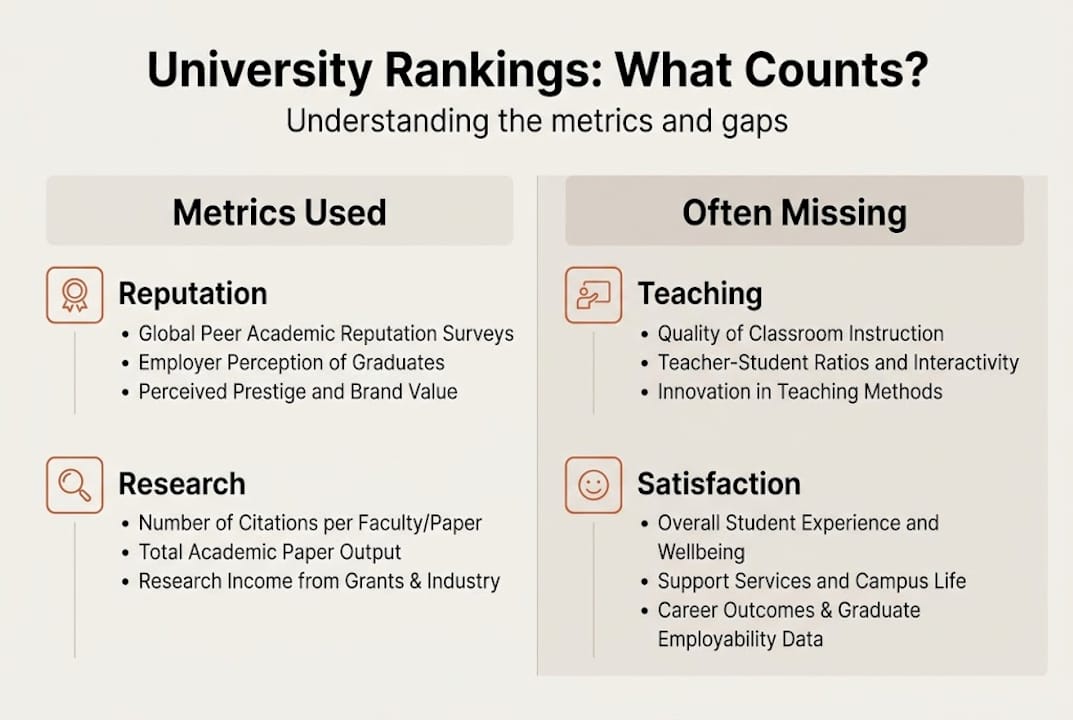
Most rankings are also biased toward science and research-heavy institutions. If you’re studying business, design, hospitality, or the arts, a university’s overall rank may tell you almost nothing about the quality of your specific program.
Key factors rankings typically include:
- Academic reputation surveys (often the largest weighted component)
- Research output and citation impact
- Faculty-to-student ratios
- International student and faculty diversity
- Employer reputation surveys
Notably absent from most rankings: actual teaching quality, student satisfaction, job placement rates in specific industries, and campus culture. These are the things that often determine whether you thrive or struggle during your studies.
Understanding how rankings are used for accreditation adds another layer. A high rank doesn’t automatically mean a degree is recognized in every country or sector.
Pro Tip: Before relying on any ranking, check its methodology page. Look specifically at how much weight is given to reputation surveys versus objective data. Reputation surveys are subjective and tend to favor older, well-known institutions over newer, innovative ones.
How rankings influence student choices in the UAE
The UAE’s higher education landscape is unlike most other countries. It operates with a market-driven approach, where universities from around the world set up branch campuses in Dubai and Abu Dhabi, competing for international students. Rankings play a significant role in this environment, but not always in the way you’d expect.
University reputation is the dominant factor (beta=0.673) in student mobility decisions across 50 countries, and the UAE is no exception. Students researching programs in Dubai or Abu Dhabi frequently filter their options by institutional rank before looking at anything else.

But rankings also affect UAE policy in a concrete way. The UAE government uses ranking criteria to determine which foreign degrees are officially recognized for Emirati students studying abroad, typically requiring universities to appear in the top 100 in the US or Australia. This means rankings have real administrative consequences, not just reputational ones.
Here’s how three Gulf countries approach rankings in their education policies:
| Country | Inbound student policy | Outbound degree recognition |
|---|---|---|
| UAE | Market-driven; branch campuses compete freely | Requires top 50-300 ranking depending on field |
| Saudi Arabia | Government-controlled scholarships tied to ranked institutions | Strict ranking thresholds for scholarship eligibility |
| Qatar | Education City model; selective partnerships with ranked universities | Formal recognition tied to home institution rank |
For you as an international student selecting universities in Dubai, this matters in two ways. First, if you plan to work in the UAE after graduation, employers here are familiar with global rankings and often use them as a screening tool. Second, if you later want your UAE degree recognized in another country, that country may apply its own ranking-based recognition criteria.
Key implications for international students in the UAE:
- Employers in the UAE frequently reference QS rankings when evaluating candidates
- Branch campuses of globally ranked universities carry the parent institution’s reputation
- Some UAE-based universities have their own strong regional rankings that matter locally
- Recognition of your degree in your home country may depend on your university’s global rank
The UAE’s approach is less prescriptive than Saudi Arabia or Qatar, but that flexibility means you carry more responsibility for verifying recognition before you enroll.
The limitations and biases of university rankings
Rankings have real power, but that power comes with serious blind spots. Understanding where rankings fail helps you avoid making a costly mistake based on incomplete information.
The most documented problems with global ranking systems include:
- Reputational feedback loops. Universities that rank highly attract more attention, more funding, and more talented researchers. This makes them rank even higher the following year. The result is that rankings tend to reinforce existing prestige rather than identify genuinely improving institutions.
- Research bias favoring sciences. Most ranking systems weight research output heavily, and scientific fields produce more citable publications than humanities or professional programs. A business school or law faculty at a top-ranked university may be far less impressive than its overall rank suggests.
- Arbitrary scoring weights. The methodological flaws in ranking systems include arbitrary scoring weights and poor subject classification, which means small changes in methodology can produce large shifts in rank with no real change in quality.
- Subject misclassification. When a university’s departments are mapped incorrectly to subject categories, its subject-level rankings can be significantly distorted, misleading students who are searching for the best program in a specific field.
“Rankings primarily measure reputation and research performance. Subject mapping errors alone can change a university’s rank by up to 6 positions, meaning the number you see may not reflect the quality of your specific program at all.” Source: pure.uva.nl
There’s also a geographic bias worth noting. Universities in English-speaking countries tend to rank higher because research published in English gets cited more often. A strong university in Germany, Japan, or the UAE may appear lower ranked simply because its research output is partly in another language or targets regional journals.
For students considering UAE universities specifically, this matters because several institutions in Dubai and Abu Dhabi are genuinely strong in specific programs like engineering, business, and hospitality, even if their overall global rank doesn’t reflect that strength.
Pro Tip: Use subject-specific rankings rather than overall university rankings whenever possible. QS and THE both publish rankings by subject area, which are far more relevant to your actual program choice than an institution’s overall position.
Making university rankings work for you: Practical strategies
Rankings are a tool, not a verdict. Used correctly, they can sharpen your search significantly. Used incorrectly, they can lead you toward a prestigious name that’s a poor fit for your actual goals.
Research on US News rankings shows that rankings influence high-ability students’ matriculation decisions in measurable ways. That influence is real, but it doesn’t mean the highest-ranked option is always the right one for you.
Here’s a practical step-by-step approach for using rankings in your UAE university search:
- Define your priorities first. Before opening any ranking table, write down what matters most to you: research opportunities, teaching quality, career placement, campus culture, cost, or location within the UAE.
- Compare at least two ranking systems. Check both QS and THE for any university you’re seriously considering. If they differ significantly, dig into why. The gap often reveals something important about the institution’s strengths.
- Switch to subject-level rankings. Once you have a shortlist, look at subject-specific rankings for your intended field. A university ranked 200th overall might be ranked 40th in your discipline.
- Verify UAE recognition policies. Check whether the UAE Ministry of Education recognizes degrees from your target institution. This is especially important if you plan to work in the public sector or a regulated profession after graduation.
- Read student outcome data. Look for graduate employment rates, industry partnerships, and alumni networks. These factors rarely appear in rankings but often predict career success better than a university’s research output.
Additional factors to evaluate alongside rankings:
- Accreditation status in the UAE and internationally
- Language of instruction and support services for international students
- Scholarship and financial aid availability
- Campus location and proximity to industry hubs in Dubai or Abu Dhabi
When finding your perfect UAE university, rankings are a useful starting filter, but they should never be the final word.
Pro Tip: Always cross-reference a university’s ranking with its official accreditation status in the UAE. A globally ranked institution without local accreditation may create problems for your visa, your degree recognition, or your career prospects in the region.
Why rankings alone aren’t enough: A fresh perspective
Here’s something most ranking guides won’t tell you: the students who struggle most in the UAE are often those who chose their university based almost entirely on prestige. They picked the highest-ranked name they could afford, arrived in Dubai, and found the campus culture, teaching style, or peer network didn’t match what they needed to succeed.
Rankings are stable metrics. They change slowly and reflect decades of institutional momentum. But your goals, your learning style, and the UAE’s job market are not static. They shift constantly.
The UAE’s higher education sector is unusually diverse. You can study at a branch campus of a globally ranked university, at a strong regional institution with deep local industry ties, or at a specialized school with a focused professional network. None of those options is automatically better than the others. The right choice depends on what you’re building toward.
We’ve seen students thrive at universities that rank outside the global top 500, because those institutions offered smaller classes, stronger mentorship, and direct connections to employers in the UAE. We’ve also seen students feel lost at prestigious branch campuses that prioritized research over student support.
Rankings are where your search should start. They should never be where it ends.
Find your ideal UAE university with expert tools
You’ve done the hard work of understanding rankings. Now it’s time to translate that knowledge into a real decision. Knowing what rankings measure and where they fall short is only useful if you can apply it to actual programs and institutions that fit your profile.
Find My Uni makes that next step straightforward. Our AI-powered University Finder Dubai tool matches you with accredited UAE programs based on your academic background, career goals, and personal preferences, going well beyond a simple ranking filter. We also provide guidance on admission requirements, visa processing, housing, and arrival support so you’re not navigating this alone. Start your search today and find the program that’s genuinely right for you.
Frequently asked questions
Do university rankings affect recognition of my degree in the UAE?
Yes, the UAE applies ranking thresholds to determine which foreign degrees are officially recognized, typically requiring universities to fall within the top 50 to 300 globally depending on your field and the country where you studied.
What are the main differences between QS, THE, and ARWU rankings?
QS and THE weight reputation and teaching environment more heavily, while ARWU focuses almost entirely on research output and Nobel laureates. The rankings vary significantly between systems, which is why comparing at least two before deciding is essential.
How can international students avoid common pitfalls when using rankings?
Compare multiple ranking systems, understand their methodologies, and weigh teaching quality and official recognition alongside scores. The reputational bias built into most ranking systems means a lower-ranked institution may actually serve your specific goals better.
Do rankings change often, and should I worry about yearly shifts?
Most global rankings are stable year-to-year, with only minor fluctuations caused by methodology updates or changes in reported data. Focus on multi-year trends rather than single-year movements when evaluating a university’s trajectory.