UAE university tuition fees: costs, factors & smart choices

TL;DR:
- Tuition fees in UAE universities vary based on location, program, and student nationality.
- Additional costs like registration, VAT, and materials often increase the total expense beyond tuition fees.
- Researching, comparing offers, understanding contracts, and planning finances are key to managing costs effectively.
Tuition fees across UAE universities are not a flat, predictable number. They shift based on where you study, what you study, and whether you hold a local or international passport. Many students arrive expecting a single ballpark figure and leave confused by the range. Fees are steadily rising due to inflation, infrastructure investments, and surging demand for quality education, especially in Dubai and Abu Dhabi. This guide breaks down what drives those costs, how they compare across universities and programs, what hidden charges catch students off guard, and what smart moves you can make before signing anything.
Table of Contents
- What determines university tuition fees in the UAE?
- How do tuition fees vary by university and program?
- Common misconceptions and hidden costs for international students
- Smart strategies for managing tuition and evaluating value
- A fresh perspective: What most students miss when planning for UAE tuition
- Find the right university and get support with your tuition decisions
- Frequently asked questions
Key Takeaways
| Point | Details |
|---|---|
| Tuition varies by emirate | Dubai and Abu Dhabi universities charge higher fees than others in the UAE. |
| International fees are higher | Non-local students face increased tuition, VAT, and additional administrative charges. |
| Contracts determine refunds | Refund policies are governed by legal contracts and may vary by institution. |
| Smart planning saves money | Proactive strategies like scholarship research and budgeting can significantly reduce tuition costs. |
| University comparisons matter | Using comparison tools helps you make informed decisions about the true cost and value at UAE universities. |
What determines university tuition fees in the UAE?
Tuition fees in the UAE are not set by a single authority. Each university operates under its own pricing model, shaped by a mix of economic, geographic, and institutional factors. Understanding these drivers helps you move past the sticker shock and ask the right questions.
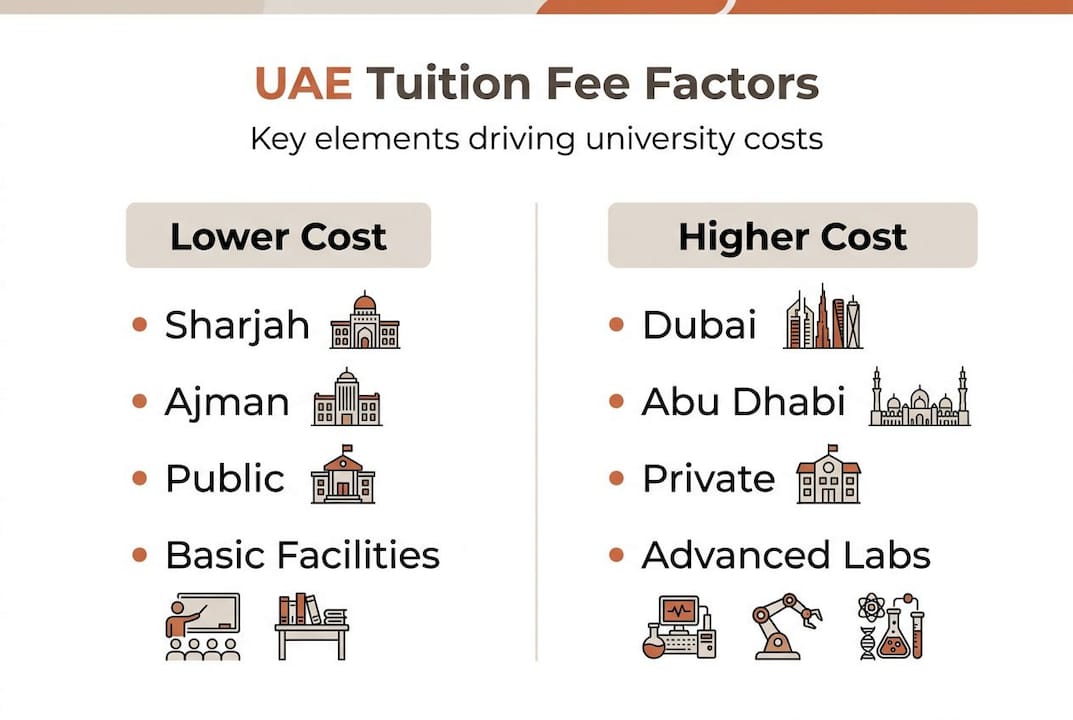
Location is one of the biggest cost drivers. Dubai and Abu Dhabi universities consistently charge more than institutions in Sharjah, Ajman, or Ras Al Khaimah. This is tied to higher operating costs, premium campus infrastructure, and the concentration of internationally ranked programs. Dubai and Abu Dhabi are more expensive than other emirates, and that gap is growing each year.
Inflation and investment play a direct role. Universities are expanding campuses, hiring globally recognized faculty, and upgrading technology facilities. These costs get passed on through annual fee increases, often ranging from 3% to 7% per academic year.
Private versus public status matters. The UAE has very few fully public universities open to international students. Most options are private, and private institutions have greater flexibility to set and raise fees without regulatory caps on increases.
Your student status changes the number entirely. International students typically pay a different rate than UAE nationals or GCC citizens. This is not always advertised clearly on university websites, so always confirm which pricing tier applies to you when reviewing a tuition fee structure guide.
Here is a summary of the key factors that shape what you will pay:
- University location: Dubai and Abu Dhabi command premium pricing
- Program type: STEM, medicine, and business programs cost more than humanities
- Level of study: Postgraduate programs often carry higher per-credit costs
- Student nationality: International students face separate pricing tiers
- Annual inflation adjustments: Most universities increase fees each academic year
- Accreditation and ranking: Globally ranked programs often charge a premium
| Factor | Lower cost impact | Higher cost impact |
|---|---|---|
| Location | Sharjah, Ajman | Dubai, Abu Dhabi |
| Program field | Humanities, social sciences | Medicine, engineering, business |
| Student status | UAE national | International student |
| University type | Semi-public | Fully private |
Pro Tip: Request the official fee schedule directly from the admissions office, not just the website. Published figures are sometimes outdated by a semester or more.
How do tuition fees vary by university and program?
Now that you understand what shapes fees, let’s look at what those numbers actually look like. Tuition in the UAE spans a wide range, and the difference between the cheapest and most expensive programs can be more than AED 100,000 per year.
Undergraduate programs at universities in Sharjah or Ajman can start around AED 25,000 to AED 40,000 per year. In Dubai and Abu Dhabi, the same level of study at a well-ranked private university typically runs between AED 55,000 and AED 100,000 annually. Postgraduate programs, especially MBAs and specialized master’s degrees, often push past AED 120,000 per year at top institutions. Dubai and Abu Dhabi universities charge consistently higher fees than those in other emirates, and this is reflected across nearly every field of study.
| Emirate | Undergraduate (AED/year) | Postgraduate (AED/year) |
|---|---|---|
| Dubai | 55,000 to 100,000 | 80,000 to 150,000 |
| Abu Dhabi | 50,000 to 95,000 | 75,000 to 140,000 |
| Sharjah | 25,000 to 50,000 | 40,000 to 80,000 |
| Ajman / RAK | 20,000 to 40,000 | 35,000 to 70,000 |
These are approximate ranges. Actual fees depend on the specific institution and program.
Here is a step-by-step approach for comparing fee offers across universities:
- Identify your shortlist. Choose three to five universities that offer your target program. Use platforms built for finding universities by tuition to filter by cost and location.
- Request itemized fee breakdowns. Ask each university for a full cost sheet, not just tuition. Registration fees, lab fees, and materials costs are often listed separately.
- Check the credit hour model. Some universities charge per credit hour, others charge flat semester fees. Calculate total credits required to graduate before comparing.
- Confirm the international student rate. Make sure the figure you are comparing is the rate for international applicants, not the domestic rate shown by default.
- Factor in annual increases. If a four-year program starts at AED 60,000, assume a 5% annual increase and budget accordingly.
Postgraduate programs often include additional costs tied to thesis supervision, research materials, or professional certifications bundled into the degree. Always ask what is and is not included in the quoted figure.
Common misconceptions and hidden costs for international students
Many students compare tuition figures and think they have the full picture. They do not. The visible fee is often just the starting point, and international students are particularly vulnerable to costs that appear only after enrollment.
Misconception 1: The listed fee is what you pay. Most universities charge additional fees for registration, student services, library access, and technology. These can add AED 3,000 to AED 8,000 per year on top of tuition.
Misconception 2: VAT does not apply to education. While core educational services are VAT-exempt in the UAE, some ancillary services, such as accommodation, parking, or professional development add-ons, may carry a 5% VAT charge. International students may pay more than locals and need to factor in VAT, refund policies, and contractual terms before signing.
Misconception 3: Refunds are straightforward. If you withdraw after paying, the refund process is governed by your enrollment contract and the university’s licensed capacity. It is not automatic, and partial refunds are common.
Here is a breakdown of hidden or overlooked costs to watch for:
- Application and registration fees: Non-refundable, often AED 500 to AED 2,000
- Health insurance: Some universities require you to purchase their plan
- Visa and Emirates ID fees: Not included in tuition, typically AED 3,000 to AED 5,000
- Textbooks and course materials: Can reach AED 5,000 to AED 10,000 per year
- Lab or studio fees: Common in engineering, architecture, and design programs
- Late payment penalties: Some universities charge fees for delayed tuition installments
“Refund eligibility and amounts are tied to the university’s licensed student capacity and the terms of your signed contract. Assuming a full refund is available is one of the most costly mistakes international students make.”
Pro Tip: Before paying any deposit, ask the admissions office for the written refund policy. Read the enrollment contract carefully, particularly the clauses on withdrawal timelines and partial refunds. Get a breakdown of international fees in writing before committing.
Smart strategies for managing tuition and evaluating value
Knowing the costs is step one. Managing them strategically is what separates students who thrive financially from those who scramble mid-semester. Here are practical, actionable moves you can make right now.
-
Research scholarships early and specifically. Many UAE universities offer merit-based and need-based scholarships for international students, but deadlines are early and competition is high. Look for scholarships tied to your nationality, field of study, or academic performance. Do not wait until after acceptance to start this process.
-
Calculate your total cost of attendance, not just tuition. Add tuition, housing, health insurance, visa fees, textbooks, transportation, and personal expenses. A program that costs AED 60,000 in tuition may total AED 110,000 or more per year when you include everything.
-
Evaluate return on investment before choosing a program. Research average starting salaries in the UAE for graduates of your chosen field. A higher-cost program at a ranked university may yield faster career returns than a cheaper option with less industry recognition.
-
Use official databases and verified platforms. The UAE’s Ministry of Education maintains data on accredited institutions. Cross-reference this with university search tools that let you filter by fee range, program type, and location.
-
Negotiate payment plans. Many universities offer semester-based or monthly installment options. Spreading payments reduces financial pressure and helps you manage cash flow, especially in your first year.
-
Track annual fee increases. Ask each university for its historical fee increase rate. If a university raised fees by 8% last year, budget for a similar increase in year two and three.
Pro Tip: Refund practices and contracts at UAE universities directly affect your financial planning. Always confirm refund conditions before paying any deposit, and keep copies of all signed agreements.
Budgeting is not glamorous, but it is the single most protective tool you have as an international student navigating an unfamiliar fee system.

A fresh perspective: What most students miss when planning for UAE tuition
Most students focus on the headline tuition number. That is the wrong starting point. After working with international students navigating UAE university choices, the pattern is clear: the students who struggle financially are not the ones who chose expensive universities. They are the ones who did not read the contract.
The UAE has a distinct legal and administrative framework around education. Refund policies, fee escalation clauses, and enrollment contracts carry real legal weight here. A brochure figure means very little if you have not confirmed what happens when your circumstances change.
There is also a cultural nuance worth naming. Administrative processes in the UAE, including fee disputes and refund requests, move through formal channels. Knowing this in advance, and building relationships with your university’s finance office early, saves significant stress later.
The students who plan well treat tuition as a multi-year financial commitment, not a one-time payment. They use insider university perspectives to understand the full picture before signing anything. That mindset shift, from cost-checker to contract-reader, is what actually protects your investment.
Find the right university and get support with your tuition decisions
Navigating UAE tuition fees on your own is possible, but it takes time and the right tools. Find My Uni was built specifically for international students who want clarity without the guesswork.

You can compare UAE university tuition side by side, filter programs by fee range, and connect directly with universities that match your academic profile and budget. The platform also offers admission support, visa guidance, and housing assistance, so your transition to studying in the UAE is as smooth as possible. Whether you are exploring undergraduate options in Dubai or postgraduate programs in Abu Dhabi, Find My Uni gives you the tools to make a confident, informed decision from day one.
Frequently asked questions
Are Dubai and Abu Dhabi universities more expensive than those in other emirates?
Yes, Dubai and Abu Dhabi generally charge higher tuition fees than universities in other emirates, mainly due to greater demand, advanced infrastructure, and higher operating costs.
Do international students in the UAE pay more than local students?
International students typically pay higher tuition fees than UAE nationals or GCC citizens and may face additional charges such as VAT on certain services.
Can tuition fees be refunded if I decide not to attend?
Refunds depend on your university’s enrollment contract and are aligned with licensed capacity and legal standards; always review the refund policy terms before paying any deposit.
How can I compare fees and programs across UAE universities easily?
You can use university search platforms that provide side-by-side comparisons and detailed cost breakdowns, making it easier to evaluate your options before applying.