How to match students with UAE programs: complete guide

Choosing a university in the UAE feels overwhelming when you’re staring at dozens of institutions, hundreds of programs, and a checklist of requirements that seems to grow every time you look at it. Many international students spend months second-guessing their choices, only to realize they applied to the wrong program or missed a critical document deadline. The good news is that a structured approach, combined with the right support, turns this chaos into a clear path. This guide walks you through the UAE higher education landscape, the smartest matching methods available, how personalized counseling works, and the exact steps to apply without costly errors.
Table of Contents
- Understanding the UAE higher education landscape
- Key methods for matching students to UAE programs
- How personalized counseling maximizes program fit
- Application steps and avoiding common mistakes
- The growing role of AI in student-program matching
- Our perspective: Balancing technology with trusted guidance
- Find your perfect UAE program with Find My Uni
- Frequently asked questions
Key Takeaways
| Point | Details |
|---|---|
| Explore UAE options | Understand the types of universities, entry paths, and requirements unique to the UAE. |
| Use personalized support | Education consultants and proven frameworks raise your chances of finding top-fit programs. |
| Check credentials | Validate your documents and use expert advice to avoid admission mistakes. |
| Leverage technology | AI tools are transforming university matching, offering smarter, data-driven guidance. |
Understanding the UAE higher education landscape
The UAE hosts a surprisingly diverse mix of institutions. You’ll find public universities like UAE University and Zayed University, private institutions such as the American University of Sharjah, and international branch campuses from global universities like NYU Abu Dhabi and Heriot-Watt. Each category operates under different funding models, accreditation bodies, and admission frameworks, so understanding which type fits your goals matters before you apply.
Entry requirements vary significantly by institution and program. Most universities expect a minimum GPA, an English proficiency score, and subject-specific prerequisites for competitive programs like medicine or engineering. International students apply directly to universities, matching via program catalogs and meeting specific admission criteria like GPA, English proficiency, and subject scores.
| Requirement | Typical standard | Application route |
|---|---|---|
| GPA | 2.5 to 3.5 (varies by program) | Direct to university portal |
| English proficiency | IELTS 5.5 to 7.0 or TOEFL equivalent | Submitted with application |
| Subject prerequisites | Math, sciences, or humanities depending on program | Transcript verification |
| Credential recognition | Ministry of Education attestation for foreign qualifications | Pre-application step |
A quick note on the NAPO system: this centralized admissions platform is designed exclusively for UAE nationals and children of nationals. It processes applications based on EmSAT scores and competitive ranking. If you’re an international student, NAPO does not apply to you.
For international applicants, the essential documents typically include:
- Certified high school or university transcripts
- Valid passport copy
- English proficiency test results (IELTS, TOEFL, or equivalent)
- Personal statement or statement of purpose
- Letters of recommendation (required by some programs)
- Ministry of Education credential attestation for foreign qualifications
Understanding the factors for aligning students with the right programs early saves you from applying to schools that simply won’t accept your current academic profile.
Key methods for matching students to UAE programs
With the lay of the land in mind, you need to pick the smartest method to match to your ideal program. Four main approaches exist, and each has real trade-offs depending on your situation.
Education consultants like IDP, AECC, and UniHawk use personalized counseling to match international students to UAE programs, and they remain the primary method most students rely on.
| Method | Pros | Cons |
|---|---|---|
| Education consultant | Personalized, expert-led, handles paperwork | Costs fees, quality varies |
| Direct university application | Free, full control | No personalization, easy to miss fit factors |
| Government systems (NAPO) | Centralized, structured | Only for UAE nationals |
| AI-driven tools | Fast, data-based, scalable | Limited contextual judgment |
Here’s how a consultant typically works with you:
- Initial assessment: The counselor reviews your academic history, grades, and language scores.
- Goal mapping: You discuss career ambitions, preferred study environment, and budget constraints.
- Program shortlisting: The consultant identifies 4 to 6 programs that match your profile.
- Application preparation: They guide document collection, personal statement writing, and deadline tracking.
- Submission and follow-up: The consultant submits applications and monitors responses on your behalf.
- Post-offer support: Once accepted, they assist with visa, housing, and arrival logistics.
Pro Tip: In your first consultation, ask the counselor how many students they’ve placed in your target program and what their acceptance rate looks like. A good consultant won’t hesitate to share that data.
If you prefer a self-directed route, university finder tools let you filter programs by subject, location, tuition range, and entry requirements without needing a third party.
How personalized counseling maximizes program fit
Once you know your options, it’s time to see how personal guidance can advance your search. A skilled counselor does far more than hand you a list of universities.

They analyze your academic background alongside your career goals and personal preferences. That combination matters more than most students realize. A student with strong math scores but a passion for design might thrive in an architecture program rather than a pure engineering track. Without that conversation, the data alone won’t reveal the right fit.
The results speak clearly. UniHawk’s EIPA methodology covers four stages: Explore strengths, Identify perfect match, Prepare applications, and Achieve results. Using this framework, 93% of students receive offers from one of their top three program choices.
What separates a great counselor from an average one:
- They assess soft factors like campus culture preferences, class size comfort, and social environment
- They flag hidden costs such as student activity fees, health insurance requirements, and housing deposits
- They check program accreditation to ensure your degree is recognized in your home country and globally
- They track deadlines proactively so you never miss an early admission window
- They prepare you for interviews when programs require them
The personalized university matching process works best when you come prepared with a clear sense of what you want from your degree, not just what you want to study.
Pro Tip: Before committing to a consultant, ask for two or three references from past students who applied to UAE programs in your field. A counselor confident in their work will connect you without hesitation.
The education consultant effectiveness data consistently shows that students who use structured counseling services achieve better program alignment than those who apply independently.
Application steps and avoiding common mistakes
Having fine-tuned your program choices, get familiar with the practical application process to maximize success.
Here’s the full sequence from start to finish:
- Research programs using university websites, program catalogs, and ranking tools.
- Shortlist 4 to 6 programs that match your academic profile, budget, and career direction.
- Prepare your documents including transcripts, test scores, personal statement, and passport copy.
- Validate your credentials through the UAE Ministry of Education before submitting foreign qualifications.
- Submit applications via each university’s online portal, following their specific formatting guidelines.
- Follow up with admissions offices two to three weeks after submission to confirm receipt.
- Accept your offer and begin the student visa process immediately after receiving confirmation.
International students must ensure credential recognition via the UAE’s Ministry of Education when using foreign qualifications. Skipping this step is one of the most common and costly mistakes applicants make.
Credential recognition warning: If your high school or university transcripts come from outside the UAE, they must be officially attested by your country’s Ministry of Education and then verified by the UAE Ministry of Education. Applications submitted without this step are often rejected outright, causing delays of an entire semester.
Other frequent mistakes include submitting documents in the wrong language without certified translations, missing early application deadlines for competitive programs, and applying to programs without checking whether AI-readiness in UAE admissions criteria now factor into program selection at certain institutions.
When you’re matching students with programs systematically, these pitfalls become far less likely because each step gets checked before you move to the next.
The growing role of AI in student-program matching
Alongside traditional steps, technology is rapidly reshaping how UAE universities match you with the best programs.
AI-driven personalization is already in use. The University of Kalba uses AI for personalized degree plans through its Smart Plan system, and the UAE’s Outcomes-Based Evaluation Framework (OBEF) now emphasizes future readiness and AI integration across programs.
| Traditional matching | AI-enhanced matching |
|---|---|
| Manual review of transcripts and scores | Automated profile analysis across hundreds of data points |
| Consultant-driven shortlisting | Algorithm-generated ranked program lists |
| Reactive follow-up on applications | Predictive alerts for deadlines and acceptance probability |
| Static program catalogs | Dynamic recommendations that update with new program data |
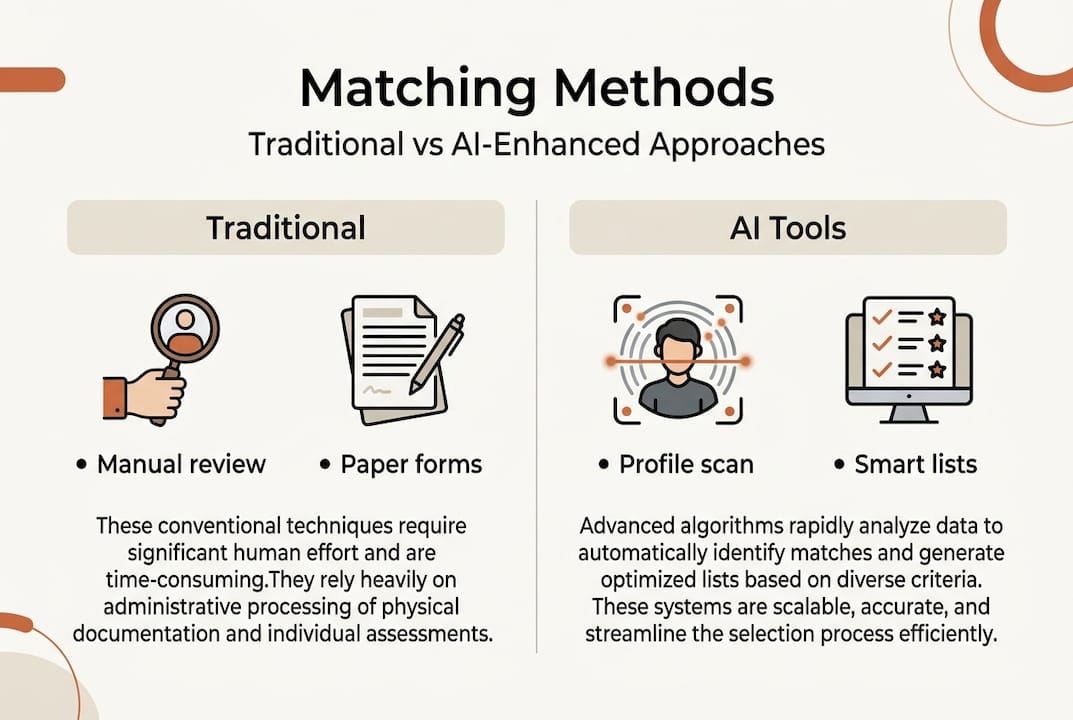
The UAE university evaluation framework has been updated to prioritize outcomes and AI readiness, which means universities themselves are becoming smarter about how they assess applicants.
What to expect from AI-enabled admissions in the next two to three years:
- Predictive acceptance scoring that tells you your likelihood of admission before you apply
- Personalized program alerts based on your academic profile and career interests
- Automated document verification that reduces processing times from weeks to days
- Smart financial aid matching that connects your profile to available scholarships automatically
- Real-time program fit scoring as you update your academic records
AI speeds up the search and broadens your view of available options. But it doesn’t replace the judgment needed to evaluate campus culture, professor quality, or long-term career network value.
Our perspective: Balancing technology with trusted guidance
The conversation around AI in education admissions tends to go one of two ways: either it’s the future that replaces everything, or it’s overhyped and irrelevant. Both views miss the real picture.
AI tools genuinely excel at benchmarking. They process thousands of data points faster than any human advisor and surface program options you might never have considered. That breadth is valuable, especially for students exploring unfamiliar fields or institutions.
But here’s what AI consistently misses: the soft factors that determine whether a student actually thrives. Campus culture, the quality of student support services, the hidden costs of living in a specific emirate, the informal professional networks tied to certain programs. These require human judgment built on real experience.
For international students navigating a region with distinct cultural norms and a complex multi-institution landscape, a blended approach works best. Use AI tools to cast a wide net and generate a strong initial shortlist. Then bring in an experienced counselor to pressure-test those choices against the factors no algorithm currently weighs. The students who succeed in UAE programs aren’t always the ones with the highest grades. They’re the ones who found the right fit, and that usually takes both data and conversation.
Find your perfect UAE program with Find My Uni
If you’re ready to put what you’ve learned into action, the next step is easy.
University Finder Dubai gives you a streamlined way to search programs by subject, location, language, and entry requirements, all in one place. The platform combines AI-powered matching with real support from advisors who know the UAE system inside out. Whether you need help shortlisting programs, preparing documents, or navigating the visa process, Find My Uni covers every stage of your journey. Start your search today and move from uncertainty to a confirmed university place faster than you thought possible.
Frequently asked questions
How do UAE universities evaluate international student applications?
Universities assess GPA, English proficiency, and subject-specific exam scores, and some programs require Ministry of Education credential recognition for foreign qualifications before processing your application.
Can I apply to UAE programs without using an education consultant?
Yes, direct applications are fully accepted by UAE universities, but self-directed applicants typically receive less guidance on program fit and may overlook critical eligibility or documentation requirements.
What role does AI play in UAE program matching today?
AI tools like Kalba’s Smart Plan are already personalizing degree recommendations, and broader AI integration across UAE admissions is expected to expand significantly over the next few years.
Is the NAPO system relevant for international students?
No, NAPO is a centralized admissions system reserved exclusively for UAE nationals and children of nationals, processed competitively based on EmSAT scores.
Do UAE universities require English proficiency tests for admission?
Most UAE universities require IELTS, TOEFL, or an equivalent English proficiency score as a standard part of the international student application process.