Guidance services for students in the UAE: succeed abroad

Most students spend months agonizing over which UAE university to pick, researching rankings, tuition fees, and campus facilities. But once they arrive, a completely different challenge takes over. Without proper guidance and support, even the most academically prepared student can struggle to adapt, fall behind, or feel completely isolated. Expatriate students face multiple challenges that go far beyond academics, including cultural adjustment, loneliness, and navigating an entirely new system. This article breaks down what guidance services actually offer, why they matter more than most students realize, and how you can use them strategically from day one.
Table of Contents
- Understanding guidance services: What do they offer?
- The real challenges for international students in the UAE
- How guidance services address student needs
- Measuring the effectiveness of guidance services
- A smarter approach to guidance: What most students and universities overlook
- Find tailored guidance for your UAE university journey
- Frequently asked questions
Key Takeaways
| Point | Details |
|---|---|
| Guidance is essential | International students thrive when they actively use support services for both academic and personal growth. |
| Early action matters | Seeking guidance from your first year can help prevent common adjustment challenges. |
| Hybrid support works best | A mix of professional and peer-based programs offers the most effective help for new students. |
| Always advocate for improvement | Regularly assess and give feedback on guidance services to ensure they meet your needs. |
Understanding guidance services: What do they offer?
Guidance services are structured support systems that universities provide to help students succeed academically, professionally, and personally. In the UAE context, these services are especially critical because the student population is highly international, with learners arriving from dozens of different countries and educational backgrounds.
At their core, guidance services include:
- Academic advising: Help with course selection, degree planning, and understanding graduation requirements
- Mentorship programs: Pairing students with faculty or senior peers who provide ongoing guidance
- Career planning: Resume workshops, internship placement, and networking events
- Peer tutoring: Subject-specific academic support from fellow students
- Wellness support: Counseling, stress management, and mental health resources
These services are delivered in different formats. One-on-one consultations give you personalized attention, while group workshops allow you to learn alongside peers facing similar issues. Some universities run structured orientation programs, while others offer drop-in sessions throughout the semester.
When choosing your UAE university, it pays to look beyond the academic rankings and ask what support infrastructure actually exists on campus.
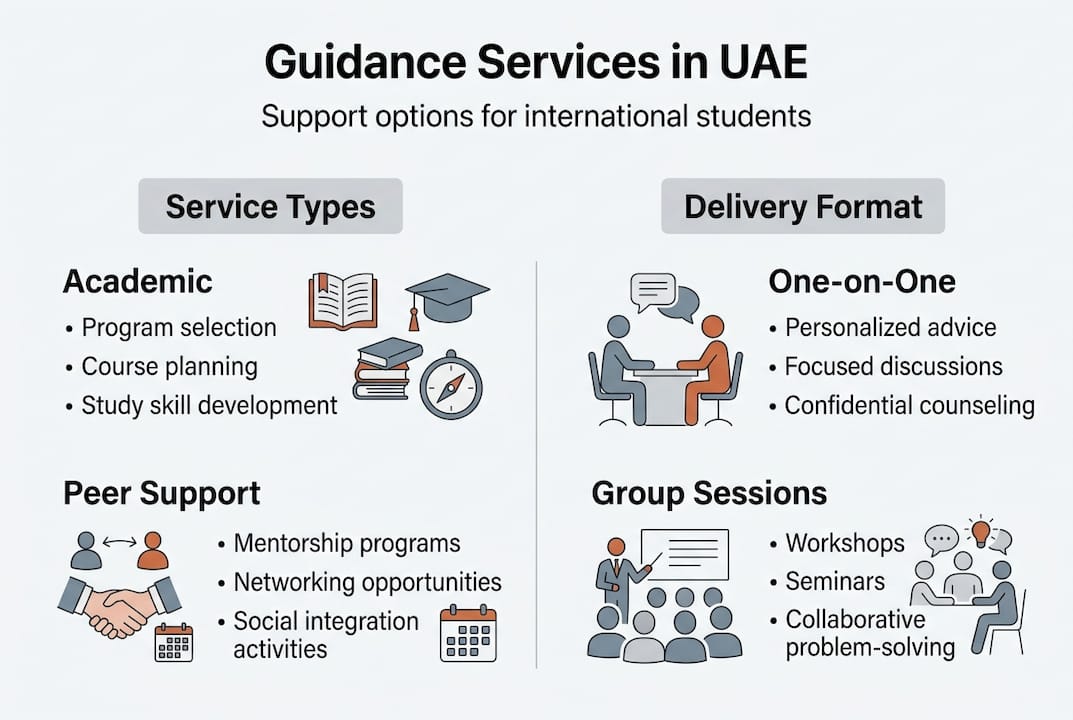
Here is a snapshot of typical guidance services at UAE universities and what they address:
| Service type | Primary focus | Delivery format |
|---|---|---|
| Academic advising | Course planning, GPA recovery | One-on-one, scheduled |
| Peer tutoring | Subject mastery, exam prep | Group or paired sessions |
| Career counseling | Job readiness, internships | Workshops, individual |
| Wellness and counseling | Mental health, stress | Confidential consultations |
| Cultural integration support | Social adjustment | Group events, buddy programs |
Empirical data from UAE research confirms that expatriate students need robust support across all these dimensions, not just academic help. The most effective universities recognize this and build layered, accessible systems to address it.
The real challenges for international students in the UAE
Knowing what guidance services offer is one thing. Understanding why they matter requires looking honestly at what international students actually go through.
Research consistently shows that loneliness, homesickness, financial strains, and academic adjustment are among the most frequent issues reported by expatriate students in the UAE. These are not minor inconveniences. They are real barriers that affect grades, mental health, and whether a student stays enrolled.
Here is how emotional and academic challenges compare in practice:
| Challenge type | Examples | Impact on student |
|---|---|---|
| Emotional | Homesickness, isolation, culture shock | Reduced motivation, anxiety |
| Academic | Different teaching styles, language gaps | Lower grades, missed deadlines |
| Social | Difficulty making friends, unfamiliar norms | Withdrawal, poor campus engagement |
| Financial | Unexpected costs, currency differences | Stress, distraction from studies |
One finding worth noting: students tend to rate their advisors highly on competence and knowledge, but satisfaction drops when it comes to the advisor’s enthusiasm and communication style. That gap matters. A technically knowledgeable advisor who seems disinterested can leave a struggling student feeling worse than before they walked in.
The difficulties faced by expatriate students in the UAE are real and well-documented. Here is how these challenges show up in everyday student life:
- Missing family milestones and feeling disconnected from home
- Struggling to follow lectures delivered in a different academic style than expected
- Feeling invisible in large classes with no clear way to ask for help
- Avoiding social events because of unfamiliar cultural norms
- Falling behind on assignments while trying to figure out administrative processes
None of these problems are signs of weakness. They are predictable outcomes of a major life transition, and they are exactly what guidance services are designed to address.
How guidance services address student needs
Guidance services do not just exist on paper. When used well, they actively shift outcomes for international students. Research points to several support mechanisms that make a measurable difference.
Here are the most effective approaches, ranked by impact:
- One-on-one academic advising: Personalized sessions where students map out their academic path, address specific struggles, and get direct feedback from a trained advisor
- Peer support groups: Structured gatherings where students share experiences and strategies, reducing isolation and building community
- Regular skills workshops: Practical sessions covering time management, academic writing, exam strategies, and career readiness
- Socialization encouragement: Organized events and buddy systems that make it easier to form genuine connections
- Self-development resources: Access to online tools, reading materials, and goal-setting frameworks
Professional consultations, peer tutoring, socialization encouragement, and self-development are all cited as important pillars of effective student support in UAE research.
Consider a first-year student from Nigeria arriving in Dubai for a business degree. She knows English well but finds the classroom dynamic unfamiliar and struggles to connect socially. By week three, she is homesick and falling behind on readings. When she finally visits the academic advising center, she is connected with a peer mentor from a similar background, enrolled in a study skills workshop, and given a clear academic plan. Within a month, her grades stabilize and she has a small but solid social circle. That is not a hypothetical. It is a pattern that plays out regularly when guidance services are used early.

The gap in current offerings tends to be communication and follow-through. Students who feel their advisor is going through the motions are less likely to return, which defeats the purpose entirely.
Pro Tip: Do not wait until you are struggling to engage with guidance services. Students who connect with peer and professional support in their first four weeks adapt faster and perform better throughout their degree.
Measuring the effectiveness of guidance services
Knowing that guidance services exist is not enough. You should also understand how to evaluate whether they are actually working, both for your own benefit and to advocate for better support when needed.
Universities typically measure guidance effectiveness through:
- Feedback surveys: Collected after advising sessions or at the end of each semester
- Retention rates: Tracking whether students continue from year one to year two
- Academic progress monitoring: GPA trends, course completion rates, and early warning flags
- Qualitative interviews: Gathering student stories to understand what is and is not working
One important finding from UAE research: senior students report higher satisfaction with academic advising than junior students do. This tells us something important. By the time students have figured out how to use the system, they are already in their final years. That is a missed opportunity. Early intervention, not late-stage support, is where the real value lies.
This gap between junior and senior satisfaction is not just a statistic. It is a signal that universities need to invest more heavily in first and second year support, when students are most vulnerable and most in need of direction.
A student satisfaction survey can be a powerful tool. If your university runs one, fill it out honestly. If it does not, ask why. Your feedback shapes the services available to the students who come after you.
Pro Tip: After each advising session, write down what was helpful and what felt lacking. Over a semester, this personal log becomes a clear picture of whether the support you are receiving is actually moving the needle.
A smarter approach to guidance: What most students and universities overlook
Here is something that rarely gets said directly: most guidance programs are built for students who already know how to ask for help. That is a fundamental design flaw.
The students who need support most, typically first-year internationals in their first eight weeks, are also the least likely to walk into an advising office unprompted. They do not know the system, they may feel embarrassed, and they often assume struggling is normal. By the time they seek help, the damage is already done.
The smarter model is proactive outreach. Advisors who reach out to students before problems escalate, peer mentors assigned before orientation week ends, and structured check-ins built into the first semester calendar. This is not radical. It is just good design.
Combining peer mentoring with professional advising also works better than either approach alone. Peers offer relatability and lived experience. Professionals offer structure and expertise. Together, they cover the full range of what a new international student needs.
Regular assessment matters too. Neither students nor universities should accept the status quo just because things seem fine on the surface. Satisfaction scores that look acceptable on average can hide serious gaps for specific student groups, particularly those from underrepresented regions or with less prior exposure to Western academic environments.
The universities that get this right treat guidance not as a service students access when they fail, but as a core part of the educational experience from day one.
Find tailored guidance for your UAE university journey
Navigating university life in the UAE is far more manageable when you have the right support in place before you arrive. Guidance is not a safety net for struggling students. It is a strategic tool that the most successful international students use from the very beginning.
At Find My Uni, we know that finding the right university is only the first step. That is why our platform is built to help you discover the right UAE university while also connecting you with the support services, admission guidance, and resources you need to thrive. Whether you are still comparing programs or already preparing to enroll, we are here to make sure you do not navigate this journey alone.
Frequently asked questions
What types of guidance services are available for international students in the UAE?
Common options include academic advising, peer mentoring, career support, and wellness programs found in most UAE universities. Research confirms these are the main support types most requested by expatriate students.
How can guidance services help with homesickness or loneliness?
Guidance staff and peer groups offer emotional support, social events, and activities that ease cultural adjustment. Expatriate students benefit most from socialization encouragement and personalized, consistent support.
Are all universities’ guidance services equally effective?
No. Some students rate advisor competence highly but see gaps in enthusiasm and communication. Senior students report greater satisfaction than juniors, pointing to a need for stronger early-year support.
How should students best use guidance services for academic success?
Engage early, attend sessions consistently, and actively seek both peer and professional advice. Early intervention and hybrid support are the approaches most strongly linked to better outcomes.