UAE university checklist: Admissions, visa & housing 2026
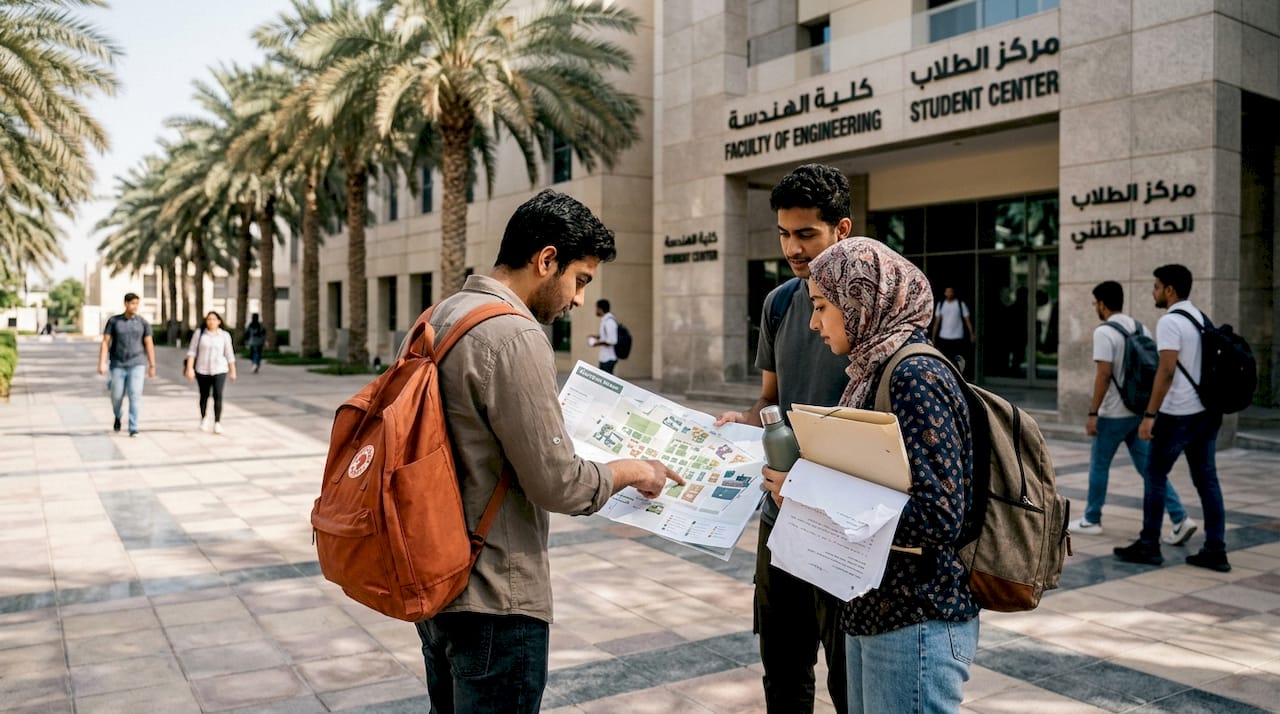
Preparing for university in the UAE as an international student is genuinely exciting, but it’s also one of the most logistically demanding transitions you’ll face. You’re not just applying to a school; you’re coordinating document attestation, a student visa, housing contracts, and cultural orientation all at once, often from thousands of miles away. This checklist walks you through every critical stage, from assembling your admissions file to settling into campus life, so nothing falls through the cracks. Whether you’re heading to Dubai or Abu Dhabi, the steps below are built around real requirements and practical timelines.
Table of Contents
- Admissions requirements: Documents, tests, and deadlines
- Visa process: Step-by-step for international students
- Housing options: Comparing on-campus and off-campus choices
- Orientation programs: Your gateway to UAE university life
- Expert tips and overlooked preparation steps
- Find your perfect UAE university
- Frequently asked questions
Key Takeaways
| Point | Details |
|---|---|
| Document preparation | Gather, translate, and attest all required admissions documents well ahead of deadlines. |
| Visa essentials | Secure proof of housing and start your visa process early to avoid delays and complications. |
| Housing comparison | Compare on-campus and off-campus options for cost, amenities, and visa suitability. |
| Orientation importance | Orientation is mandatory and vital for adapting to academic and legal life in the UAE. |
| Expert preparation tips | Start preparation months in advance and seek advice for overlooked steps and scholarships. |
Admissions requirements: Documents, tests, and deadlines
Before anything else, your admissions file needs to be complete and correctly formatted. UAE universities are competitive, and missing even one document can delay your application by weeks. Getting this right from the start saves you enormous stress later.
Here’s what most universities require:
- Valid passport with at least 6 months of remaining validity
- Attested academic transcripts from your home country’s education authority, the UAE Embassy, and the UAE Ministry of Education (MOE)
- High school certificate or equivalent (also attested)
- English proficiency scores: IELTS or TOEFL (some programs set a minimum 80% English proficiency benchmark)
- Passport-sized photographs meeting UAE specifications
- CV and/or Statement of Purpose (SOP)
- Letters of recommendation (usually two academic references)
Attestation is the process of officially verifying your documents through a chain of authorities: your home country’s education department, then the UAE Embassy in your country, then the UAE MOE. It sounds straightforward, but it can take 4 to 8 weeks depending on your country. Translation into Arabic or English is also required if your documents are in another language.
Pro Tip: Start your attestation process 3 to 6 months before your target application deadline. Delays in attestation are the single most common reason students miss their intake.
Common mistakes to avoid:
- Submitting transcripts without full attestation
- Forgetting to translate documents from a non-English or non-Arabic language
- Missing rolling deadlines (some UAE universities accept applications year-round but fill seats fast)
- Sending low-resolution scans instead of certified copies
Use a university finder Dubai tool to check program-specific requirements early, since engineering, medicine, and business programs often have different score thresholds.
Visa process: Step-by-step for international students
Once your admission is confirmed, securing your student visa is the next priority. The UAE student visa process is structured, but it requires careful sequencing of documents.
- Receive your official admission letter from the university
- Gather required documents: passport copy, admission letter, passport photos, health insurance proof, and attested academic records
- Submit proof of housing (on-campus contract or off-campus tenancy agreement)
- Apply through your university’s international student office or the UAE Federal Authority for Identity and Citizenship portal
- Attend a medical fitness test if required (common for longer-term visas)
- Collect your Emirates ID after visa approval, which is mandatory for all residents
One step that surprises many students is the housing requirement. Proof of housing is often a mandatory part of the visa application, meaning you need to sort your accommodation before your visa is finalized, not after.
“Securing your housing contract before submitting your visa application is not optional at many UAE institutions. It’s a prerequisite that directly affects your visa timeline.”
Pro Tip: Double-check whether your housing contract needs to be attested or notarized for visa purposes. Some landlords provide standard contracts that aren’t accepted by immigration authorities without an additional verification step.
If you’re still deciding between programs, find your university first, since your visa application is tied directly to your enrolled institution.
Housing options: Comparing on-campus and off-campus choices
Your housing decision affects your budget, your visa application, and your daily quality of life. Both on-campus and off-campus options have real advantages depending on your priorities.

On-campus housing is offered by most major UAE universities. It typically includes furnished rooms, utilities, campus security, and proximity to academic buildings. On-campus dorms at institutions like Khalifa University range from AED 2,450 to 3,200 per month for double occupancy, while off-campus shared apartments average AED 2,500 to 4,000 monthly depending on location and amenities.
| Feature | On-campus | Off-campus |
|---|---|---|
| Average monthly cost | AED 2,450 to 3,200 | AED 2,500 to 4,000 |
| Utilities included | Usually yes | Usually no |
| Visa documentation | Straightforward | Requires tenancy contract |
| Contract flexibility | Semester-based | 12-month typical |
| Campus proximity | Walking distance | Varies |
| Social environment | High | Moderate |
Factors to weigh when choosing:
- Budget: Off-campus can be cheaper if you split costs with 3 or 4 roommates
- Lifestyle: On-campus suits students who want community; off-campus suits those who prefer independence
- Contract length: Off-campus leases are usually 12 months, which may not align with your academic calendar
- Utility costs: Add AED 300 to 600 monthly for electricity and internet in off-campus apartments
- Visa compatibility: On-campus contracts are the easiest to use as visa proof
If you’re looking for discounted rates, committing to a minimum 4-month stay often unlocks better pricing from private student housing providers. Use a university finder Dubai resource to identify which universities offer guaranteed on-campus housing for first-year international students.
Orientation programs: Your gateway to UAE university life
Orientation is not just a welcome event. At UAE universities, it’s a structured program that covers legal requirements, cultural norms, academic expectations, and campus resources. Missing it can leave you genuinely unprepared.
At MBZUAI, for example, the mandatory graduate orientation brings together 300 or more participants for sessions covering UAE culture, Emirates ID registration, academic integrity policies, and wellbeing resources. Similar programs run at universities across Abu Dhabi and Dubai.
“Orientation is essential for cultural and legal adaptation, particularly for students arriving from diverse international backgrounds who may be unfamiliar with UAE laws and academic culture.”
What to expect during orientation week:
- Campus tours covering libraries, labs, health centers, and student services
- Faculty introductions and academic advising sessions
- Legal paperwork: Emirates ID registration, health insurance enrollment
- Cultural briefings: UAE laws on public behavior, dress codes, and social norms
- Wellbeing workshops: mental health resources, peer support networks
- Student club fairs and networking events
| University | Orientation format | Key sessions |
|---|---|---|
| MBZUAI | Multi-day mandatory | UAE culture, Emirates ID, academic expectations |
| AURAK | Welcome week | Campus tour, faculty meet, legal orientation |
| Khalifa University | Structured induction | Academic policies, housing check-in, ID registration |
To get the most out of orientation, arrive a day early if possible, bring all your original documents (you’ll need them for Emirates ID), and introduce yourself to at least one faculty advisor. The connections you make during orientation often shape your first semester experience significantly.
Check orientation essentials for a pre-arrival document checklist so you walk into orientation week fully prepared.
Expert tips and overlooked preparation steps
Orientation programs provide the initial bridge, but there are preparation steps that most guides skip entirely. These are the details that separate a smooth arrival from a stressful one.
Key expert tips for international students:
- Start 3 to 6 months early: The pre-arrival checklist from relocation experts consistently flags early preparation as the top success factor
- Review all deadlines in one place: Scholarship deadlines, housing deposit dates, and visa application windows often overlap
- Attend every orientation session: Even optional ones cover practical information that isn’t published anywhere else
- Verify your English proficiency requirement: Different programs within the same university can have different score thresholds
- Research merit-based scholarships early: Many UAE universities offer scholarships for international students, but applications close months before the academic year starts
- Connect with current students: Join official university Facebook groups or WhatsApp communities before you arrive
Pro Tip: Health insurance is mandatory for UAE residents, including students. Some universities include it in their fees; others don’t. Confirm this before you arrive so you’re not scrambling to purchase a policy on your first week.
Two overlooked items that catch students off guard: first, some countries require an apostille (a specific type of document authentication) rather than standard attestation, so check your country’s specific process. Second, bank account setup in the UAE requires your Emirates ID, which you can only get after arriving, so bring enough cash or a travel card to cover your first two weeks.
For personalized international student advice, use a platform that matches your academic profile to programs that fit your background and goals.
Find your perfect UAE university
You’ve now covered every major stage of the international student checklist: admissions documents, visa steps, housing choices, orientation programs, and expert preparation tips. The next step is choosing the right university and program for your specific goals.
Find My Uni is built specifically for students in your position. The platform uses AI-powered matching to connect your academic profile with accredited programs across Dubai and Abu Dhabi. You get personalized program recommendations, admission guidance, visa support, and housing resources all in one place. Whether you’re just starting your search or ready to apply, the uni finder Dubai tool helps you move from checklist to confirmed enrollment with confidence.
Frequently asked questions
What documents are needed for UAE university admissions?
You’ll need a valid passport, attested transcripts, high school certificate, English proficiency scores, passport photos, and often a CV or Statement of Purpose. All academic documents must go through the full attestation chain before submission.
How much do student housing options in UAE cost?
On-campus double rooms typically range from AED 2,450 to 3,200 per month, while off-campus shared apartments average AED 2,500 to 4,000 monthly, not including utilities.
Is orientation mandatory for international students?
Yes, most UAE universities require attendance. MBZUAI’s orientation is a structured multi-day program covering legal, cultural, and academic integration for all new students.
When should international students start preparing for UAE university?
Start at least 3 to 6 months early to allow enough time for document attestation, translation, scholarship applications, and housing arrangements before your intake deadline.