How to secure admission in Abu Dhabi universities

Applying to universities in Abu Dhabi can feel overwhelming for international students. The admissions landscape is decentralized, with each institution operating its own portal and requirements. Unlike centralized systems in other countries, you must navigate multiple university websites, prepare tailored documents for each program, and manage visa and housing logistics independently. This guide walks you through every step of the admission process, from understanding how applications work to preparing documents, securing post-admission support, and avoiding common mistakes that could delay your acceptance.
Table of Contents
- Key takeaways
- Understanding the admissions process for Abu Dhabi universities
- Preparing your documents and application materials
- Navigating visa, housing, and support services after admission
- Common mistakes to avoid and tips to improve your admission chances
- Find your ideal university in Abu Dhabi with expert support
- How to secure admission in Abu Dhabi universities: frequently asked questions
Key Takeaways
| Point | Details |
|---|---|
| Direct university portals | International students apply directly to each Abu Dhabi university through its own online portal, with no centralized admissions system. |
| Tailored program documents | You must customize transcripts, statements, and other materials to meet the specific requirements of each program and institution. |
| Rolling admissions timing | Many programs review applications as they arrive, so applying early improves your chances before seats fill up. |
| Post admission support | After you are admitted universities typically assist with visa procedures and housing options to help you settle in. |
Understanding the admissions process for Abu Dhabi universities
International students apply directly to individual universities in Abu Dhabi via online portals, with no centralized system for higher education admissions. This means you need to research each institution separately, create accounts on their admissions platforms, and submit applications independently. The process differs significantly from countries with unified portals like UCAS in the UK or Common App in the US.
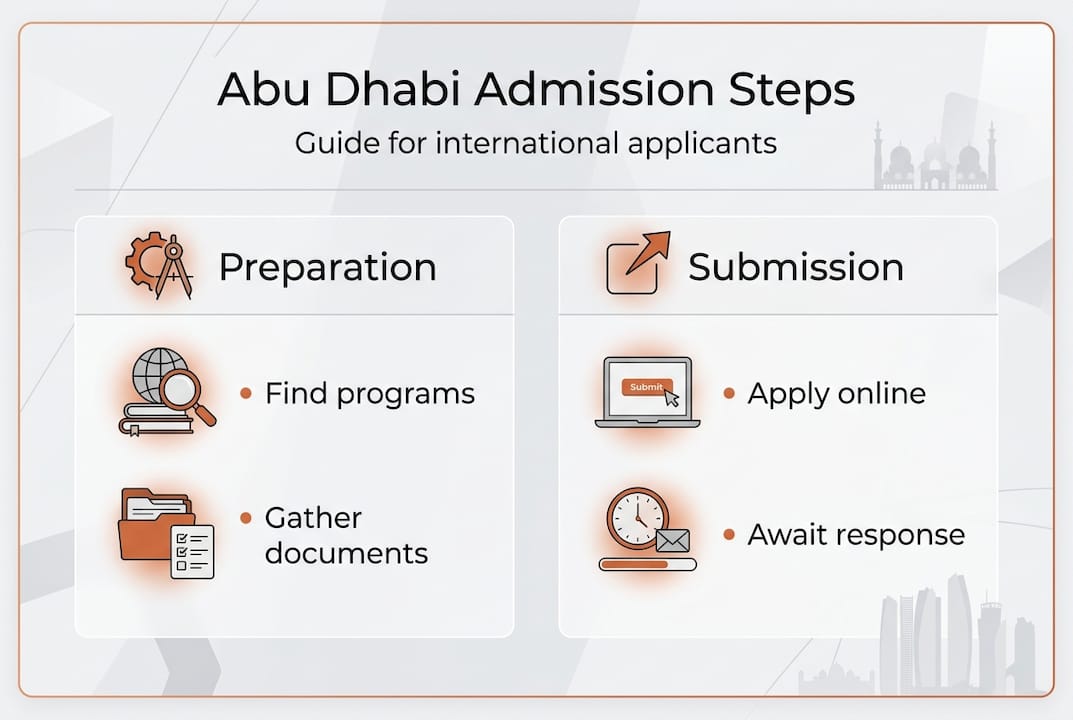
Typical application steps follow a consistent pattern across most universities. First, you select your desired program through the university’s website or a university finder platform that helps match your profile to suitable options. Next, you gather and prepare all required documents, ensuring they meet the specific criteria for your chosen field. Then you submit your complete application through the university’s online portal, paying any application fees. Finally, some programs require interviews, entrance exams, or portfolio reviews depending on the discipline.
The application requirements vary significantly by program and institution. Engineering applicants to Khalifa University, for example, need specific science subject transcripts demonstrating strong performance in mathematics, physics, and chemistry. Business programs often emphasize quantitative skills and may require GMAT scores. Creative fields like design or architecture demand portfolios showcasing your work. Understanding these nuances prevents wasted effort on applications where you don’t meet baseline requirements.
Most universities operate on rolling admissions, meaning they review applications as they arrive rather than waiting for a single deadline. This creates both opportunity and pressure. Early applicants often secure spots before programs fill, while late applicants face increased competition for remaining seats. Some highly competitive programs do set firm deadlines, so checking each university’s specific timeline is essential.
The lack of a centralized system means you control your application strategy completely. You can apply to multiple universities simultaneously, compare offers, and make informed decisions. However, this freedom requires careful organization. Missing a deadline at one university doesn’t affect others, but tracking multiple portals, requirements, and timelines demands attention to detail.
Preparing your documents and application materials
Successful applications hinge on thorough document preparation tailored to each program’s requirements. Standard materials include academic transcripts from all previous institutions, a valid passport copy, English language proficiency test scores like IELTS or TOEFL, letters of recommendation from teachers or employers, a personal statement explaining your academic goals, and sometimes a CV highlighting relevant experience. Each document serves a specific purpose in demonstrating your readiness for university-level study in Abu Dhabi.

Customization separates accepted applications from rejected ones. Generic documents signal lack of genuine interest, while tailored materials that match program specifics show you’ve researched the university and understand what they value. If applying to an engineering program, emphasize your mathematics and science achievements prominently in your personal statement. For business programs, highlight leadership experiences and analytical projects. This targeted approach demonstrates fit and increases your chances significantly.
Document formatting and translation standards matter more than many applicants realize. Universities typically require official transcripts, meaning they must come directly from your previous institution in a sealed envelope or via secure electronic transmission. If your transcripts are in a language other than English, you need certified translations from approved translators. Passport copies must be clear and valid for at least six months beyond your intended start date. Test scores should be sent directly from testing organizations when possible.
Additional assessments vary widely by program and university. Some institutions require entrance exams testing subject knowledge or aptitude. Others conduct interviews via video call to assess communication skills and motivation. Creative programs need portfolios demonstrating your abilities. Research programs may ask for writing samples or research proposals. Understanding these requirements early allows adequate preparation time rather than scrambling at the last minute.
Digital organization saves time and reduces stress throughout the application process. Create a folder system on your computer with subfolders for each university, containing all required documents in the correct formats. Keep a spreadsheet tracking deadlines, required materials, submission status, and follow-up actions for each application. Scan physical documents at high resolution so they remain legible when submitted online. Having everything organized and ready means you can submit applications quickly when portals open.
Pro Tip: Request recommendation letters at least six weeks before your earliest deadline. Professors and employers need time to write thoughtful letters, and last-minute requests often result in generic recommendations that don’t strengthen your application. Provide your recommenders with your resume, personal statement draft, and specific points you’d like them to address to help them write more compelling letters.
Navigating visa, housing, and support services after admission
Once you receive an admission offer, universities take responsibility for facilitating your transition to Abu Dhabi. Universities sponsor student visas for international students, managing the entire process including medical screening and Emirates ID application. This sponsorship is crucial because you cannot obtain a student visa independently. The university acts as your legal sponsor throughout your studies, handling renewals and ensuring compliance with UAE regulations.
The visa process involves several mandatory steps coordinated by your university’s international student office. First, you undergo medical screening at approved facilities, including chest X-rays and blood tests to check for communicable diseases. These tests must be completed in the UAE after arrival on an entry permit arranged by the university. Next, you apply for your Emirates ID, the official identification card required for all residents. The university submits your visa application to immigration authorities and tracks its progress. Finally, you receive your student visa, typically valid for one year and renewable annually as long as you maintain good academic standing.
Student visa validity and renewal follow a predictable pattern that requires attention to timing. Initial visas are usually issued for one year from the date of entry. Before expiration, your university initiates the renewal process, typically starting two to three months in advance. Renewal requires proof of continued enrollment, satisfactory academic progress, and updated medical screening. The process becomes routine after your first year, but missing renewal deadlines can result in fines or legal complications.
Housing assistance varies by institution but most universities provide substantial support to international students. Some universities operate on-campus dormitories with guaranteed spots for first-year international students. Others maintain partnerships with nearby housing complexes offering student rates and shuttle services. Even universities without direct housing options typically employ staff who help students find suitable apartments, understand rental contracts, and navigate the local housing market. Starting your housing search early through university resources ensures you secure accommodation before the semester rush.
Additional support services help international students adapt to life in Abu Dhabi beyond visa and housing logistics. Universities organize orientation programs covering everything from opening bank accounts to understanding local customs and transportation options. Many institutions assign peer mentors, current students who answer questions and help newcomers adjust. International student offices remain available throughout your studies to address concerns, renew documents, and provide guidance on academic or personal challenges.
Pro Tip: Initiate your visa process immediately after accepting your admission offer, even if your start date is months away. The medical screening, document collection, and administrative processing can take six to eight weeks. Early action prevents last-minute complications and ensures you arrive on campus relaxed and ready to focus on academics rather than paperwork.
Common mistakes to avoid and tips to improve your admission chances
Incomplete or generic applications represent the most frequent mistake international students make when applying to Abu Dhabi universities. Submitting documents that don’t meet specified requirements, like unofficial transcripts or expired test scores, triggers immediate rejection or delays while you scramble to provide correct materials. Similarly, using the same personal statement for every university without customizing it to each program’s focus signals lack of genuine interest. Admissions committees can spot generic applications instantly, and they rarely advance to the acceptance stage.
Missing early application deadlines severely impacts your chances in systems with rolling admissions and competitive spots. Universities begin reviewing applications as they arrive, extending offers to qualified candidates immediately. By the time late applicants submit materials, many spots are already filled. Even if the official deadline hasn’t passed, your application competes against fewer available seats. Popular programs in business, engineering, and medicine fill especially quickly, sometimes months before final deadlines.
Poor communication responsiveness creates unnecessary obstacles throughout the admissions process. Universities may request additional information, schedule interviews, or ask for document clarification. Delayed responses suggest lack of interest or organizational skills, potentially costing you an acceptance. Check your email daily during application season, including spam folders where university messages sometimes land. Respond to all inquiries within 24 to 48 hours, even if just to acknowledge receipt and promise a complete response soon.
Neglecting to research program-specific requirements leads to wasted applications and missed opportunities. Not every university offers every program, and admission criteria vary significantly even for similar degrees at different institutions. Applying to a program without the prerequisite coursework or minimum test scores guarantees rejection. Spending time upfront to verify you meet baseline requirements and understand what each program values saves application fees and focuses your energy on realistic options.
Underestimating the importance of English language proficiency affects both admission chances and academic success. Many international students submit minimum required IELTS or TOEFL scores without recognizing that higher scores strengthen applications significantly. Universities use language scores not just as gatekeepers but as predictors of academic performance. Strong English skills also determine your ability to participate in discussions, write papers, and engage with course materials effectively once enrolled.
Pro Tip: Apply to at least three to five universities with varying selectivity levels to maximize your chances of acceptance and create options for comparing offers. Include reach schools where your profile is slightly below average, target schools where you match typical admitted students, and safety schools where you exceed normal requirements. This strategy ensures you receive multiple acceptances and can choose the best fit rather than settling for your only option.
Find your ideal university in Abu Dhabi with expert support
Navigating multiple university portals, tailoring applications, and managing post-admission logistics can feel overwhelming when you’re doing it alone. Find My Uni simplifies this entire journey by connecting you with universities in Abu Dhabi that match your academic profile and career goals. Our AI-powered platform analyzes your qualifications, preferences, and aspirations to recommend programs where you’ll thrive, eliminating guesswork from the selection process.
Beyond university matching, we provide comprehensive support throughout your application journey. Our expert advisors help you prepare strong applications, review your documents before submission, and guide you through visa processing and housing arrangements. We’ve helped thousands of international students secure admission to top universities in Abu Dhabi and Dubai, and our success stories demonstrate the value of expert guidance. Start exploring your options with our university finder today and take the first step toward your academic future in Abu Dhabi with confidence and support.
How to secure admission in Abu Dhabi universities: frequently asked questions
When is the best time to apply to universities in Abu Dhabi?
Apply six to nine months before your intended start date to maximize your chances. Most universities have rolling admissions, so earlier applications compete for more available spots. Fall semester typically begins in September, making January through April the ideal application window, while spring semester starts in January with optimal applications submitted by August.
Is there a centralized application portal for Abu Dhabi universities?
No centralized system exists for university applications in Abu Dhabi. You must apply directly to each institution through their individual online portals. This differs from systems like UCAS or Common App, requiring separate applications, document submissions, and fee payments for each university you’re considering.
What support services do universities provide after admission?
Universities sponsor your student visa, coordinate medical screening, facilitate Emirates ID application, and provide housing assistance or guidance. Most institutions also offer orientation programs, peer mentoring, academic advising, and ongoing support through international student offices throughout your studies.
How long is a student visa valid and how do I renew it?
Student visas are typically valid for one year from issuance and must be renewed annually. Your university initiates the renewal process two to three months before expiration, requiring proof of enrollment, satisfactory academic progress, and updated medical screening. The university manages renewals as your official sponsor.
Do I need to attend interviews for university admission in Abu Dhabi?
Interview requirements vary by program and institution. Many programs admit students based solely on documents, while competitive programs in medicine, business, or specialized fields may require video interviews. Some universities also conduct entrance exams or request portfolio reviews for creative disciplines, so check specific program requirements early.
Can I apply to multiple universities simultaneously in Abu Dhabi?
Yes, you can and should apply to multiple universities simultaneously since there’s no centralized system limiting applications. Applying to three to five institutions with varying selectivity levels gives you options to compare offers, scholarships, and program fit before making your final decision.